
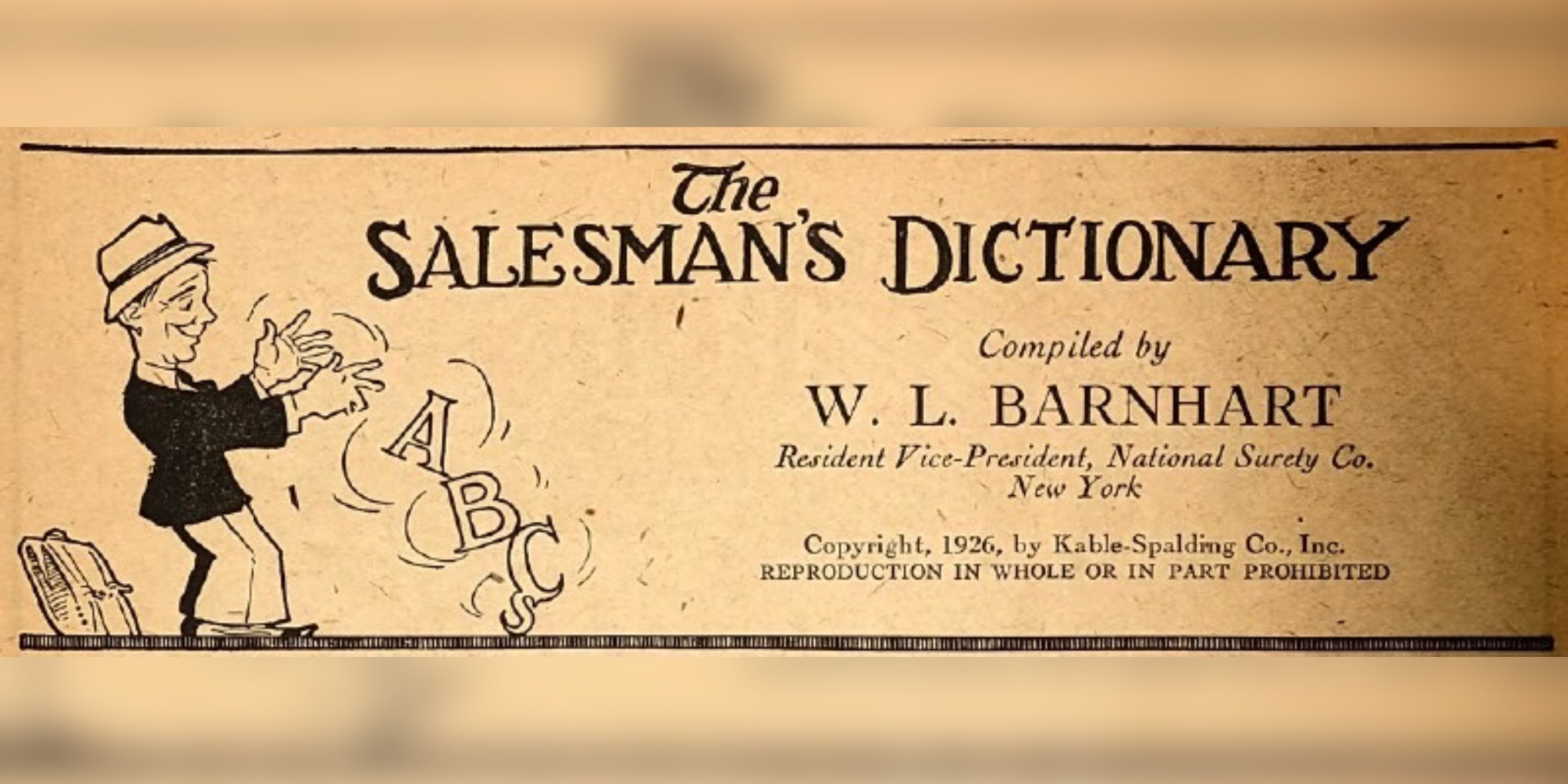
Sales Definitions Salespeople Should Know, Letters A through K from 1926
Starting in May’s edition of How to Sell magazine in 1926, W.L. Barnhart compiled something he called the “Salesman’s Dictionary”. Each month included another set. While there are so many definitions, many of which are obvious, I’m going to highlight some of the more interesting ones here, and you’ll see my commentary on why I highlighted the ones I did in italics.
(Unfortunately, I only have the editions through December of 1926…so I only get through half the alphabet here. Will continue to search until I find the back half of these)
Ability – Power to perform. Ability is base of Arthur Frederick Sheldon’s famous “AREA” rectangle of qualifications for success: “A” is for Ability, “R” is for Reliability, “E” is for Endurance, and “A” is for Action.
I literally have a sticky note on my monitor in my office with that acronym on it from Sheldon…who also named an entire city from this sales methodology acronym (Area, Illinois…which is now Libertyville / Mundelein), and a lake, too!
*And by the way, you may notice some of the English is a little off, like “Ability is base of…” above. That’s word-for-word.
Admission – One method of handling objections is to admit prospect’s contention is correct or natural, but that certain facts should be given further consideration. This plan disarms prospect, because you first agree with him.
This has a little scent of transparency in it…I would argue that it’s better to lead with the truth. In second place is admitting the truth, maybe without the spin he’s suggesting here at the end.
Advance – Any sum of money paid by employer to salesman in anticipation of commissions to be earned. Unless there is definite understanding to contrary, all outstanding advances are cancelled with termination of salesman’s employment.
In today’s terms, we’d probably refer to this as a recoverable draw.
Age – A factor in salesmanship. Various articles are best suited to salesmen of different ages. Salesman should select some article usually sold by those of own age, in order to achieve maximum success.
Funny to look at the “wanted” job postings for salespeople from that era. The majority of them specified the age bracket they were looking for. And, all job applications included “age” as a required field.
Alibi – An excuse for failure. In law, an alibi is proof that accused was elsewhere at time crime was committed, but in sales slang an “alibi” is any explanation a salesman may offer to account for lack of success.
I love this one…a term that maybe we should bring back?
Appearance – Personal aspect. Every salesman should be extremely careful of personal appearance, since customer is seeing salesman throughout talk, and anything in personal appearance that might create unfavorable impression might easily prevent sale.
In many of the old books and magazines, entire sections are dedicated to the appearance of the salesperson, both men and women. Personal hygiene was something that needed to be taught, but also the flashiness of one’s attire.
Apology – Making of excuses. Poor salesmen apologizes for taking buyers’ time; good salesman never does, for he knows interview will profit prospect more than salesman.
I see this bandied about on LinkedIn every once in a while, the fact that we should stand tall in conversations with prospects, as our time is just as valuable as theirs.
Art of Salesmanship – Salesmanship is both a science and an art. Science deals with formulation of definite principles, Art with application of those principles to attain desired regular, i.e., easy and uniformly successful completion of a sale.
Funny that there are still posts today, literally 100 years later, where people ask, “Is sales an art or a science?” Come on…
Bagman – A commercial traveler. One employed to solicit orders for manufacturers.
If you’ve ever heard the phrase that many use today where a leader says, “I used to carry a bag,” or anyone says, “Earlier in my career I carried a bag”, this phrase goes back to the 1800s. Think about a salesperson, representing multiple textile manufacturers, riding from town to town by horseback with saddlebags carrying samples. That’s the “bag” they’re referring to – those salespeople and their saddlebags.
Big Man – A prospect who, because of his money or position, looks “big” to the salesman. Successful salesmen soon learn that there is really no difference between “little” men and “big” ones, except as the salesman creates obstacles in his own mind.
It took me a long time to realize this one. Recently, I had a chance to reconnect with a person who was on the board of directors for the first company I ever had to interact with a board with on a regular basis. I was so intimidated back then. Now, realized he’s a regular clown just like you and me.
Bribery – Influencing a sale by the gift of money or other valuable consideration to those who will have placing of order. This practice is not permitted by best sales managers, and usually results in discharging of salesman guilt of giving bribe.
I’ve read some articles from the era not only talking about “side deals” with buyers, where they’re given under-the-table money to go with a solution, but even articles saying that one-off discounts are a form of commercial bribery. It’s a solid argument – when each client is paying a different amount based on the negotiation itself. (shameless self-promotion… you can fix this easily with Four Levers Negotiating)
Bring Home the Bacon – This phrase may have originated in the olden days when gos ran wild in the forests, and every Autumn it was customary to hunt them down. Only of late years that the phrase has come to apply to all things that one realy wants and that compel one to go out in the world and earn them.
I know I’m old, but the first time I had heard the term “bring home the bacon” was on an Ejoli Perfume commercial from 1982. Apparently, it’s an old-fashioned term meaning to bring home the money.
Browbeat – To bend a prospect to the salesman’s will be arrogant speech or dogmatic assertions. No real salesman will resort to browbeating of prospects.
The 1920s represented a time when salespeople were becoming much more aggressive. The progressive era of the industrial revolution led to many manufacturing breakthroughs, but during the early 1920s “forgotten depression”, there was suddenly a ton of extra inventory (which is expensive), lots of idle machines (also very expensive), and desparate leaders forcing salespeople to place much more pressure on prospects and customers.
Canvass – (v) To search thoroughly through a district. Canvass means literally to sift out through a piece of canvas. It would be better for most salesman if they adhered more closely to the literally meaning in thoroughly canvassing their territory. (n) A systematic effort to obtain buyers.
Two definitions that both mean what we call “prospecting” today. I found it beginning to be referred to as prospecting around 1920, specifically in Norval Hawkins’ book Certain Success, where he was comparing the process of prospecting to mining for gold.
Character Analysis – The theory that the salesman can tell from observation of the contour of the head and other physical characteristics regarding the character and habits of the prospect. This theory has many proponents, but is assailed as unscientific by others.
Phrenology and physiognomy were prevalent methodologies used in sales organizations in the 1910s and 1920s. During the World Sales Congress in 1916, two of the keynote speakers were noted phrenologists. Companies like Ford Motor Company swore by their teachings, encouraging salespeople to sell cars based on the shape of the buyer’s head. Many of the books in collection have entire sections or chapters dedicated to this approach. It all reads crazy to me…
Decision – Act of deciding. A salesman’s whole sales talk is for the purpose of inducing a decision favorable to his goods.
I’d argue the whole sales talk is for the purpose of helping buyers decide quickly, even if that decision is not for “his goods.” Win fast, lose fast. Do the homework for the buyer. Embrace The Transparency Sale.
Dope – Getting the “dope” on your prospects means getting all possible information regarding them from all possible sources.
Doing homework on your buyers and tailoring your engagement with them is not a new concept. There was information available, even 100 years ago! Get the “dope” on your prospects.
Dotted Line, Getting Name On – The final step of the sale is getting the prospect to sign the order blank on the dotted line put there for the purpose.
I’ve always heard this, but in trying to understand whether contracts always had a purposeful “dotted line”, there doesn’t really seem to be an era where that was the case. But it’s a phrase that goes back a long way. It seems to come from the era of printed commercial forms and order blanks, where dotted or broken lines were a practical visual cue as to the place to sign. But often there was an X next to a solid line, sometimes a seal, or other markings that made it obvious where a customer would sign.
Dropped In – An expression used by incompetent salesman in opening interview. A good salesman never “drops in”. He makes each call of great importance. Makes each prospect feel that call was specifically arranged for him alone.
This is an interesting callout. I may have been guilty of saying this earlier in my career, too. “Hey, I’m going to be in the area, would love to drop in and see you.” The writer argues that this meeting is purely for the salesperson’s convenience, and isn’t important enough for the customer to have warranted a specific visit.
Grip – Traveling bag often carried by salesmen. Hence the expression, “Knights of the grip.”
In the early 1900s sales book, the term “grip” comes up a lot. This seems to have represented the switch from “carrying a bag” as talked about with “bagmen” above, to the era of salespeople having a briefcase with a handle that you gripped onto. So, the salesperson and their “grip” meant a traveling salesperson carrying their briefcase.
High Pressure – A method of selling by which salesman attempts to force prospect to buy at once.
As mentioned above under the term “brow beat”, the phrase “high pressure sales” became a subject of intense debate in many of the periodicals, which many believing that high pressure sales was the way forward in the profession, saying that “low pressure” sales is merely order taking. However, high-pressure sales approaches were the beginning of the end of any positive association between the profession and trust.
House Organ – Periodical publication of “the house.” May be printed, multigraphed, mimeographed or typewritten for circulation among salesmen, branch office managers, dealers or customers.
From the 1890s onward, organizations sent newsletters out to their remote salespeople around the country, and even the world. These were all called “house organs”, which served to educate, celebrate, motivate, and communicate with their salespeople before the time of emails, Slack, Zoom calls, and everything else used today to serve that same purpose.
Inertia – That property of matter by which it tends when at rest to remain so, or when in motion to continue in motion. Often noticed among salesmen. When they’re not selling properly they find it harder to “get started,” and when successful it’s easier to go on to yet larger success.
It’s a great callout. I sometimes feel it in my own business. When it rains, it seems to pour. And it’s hard not to feel the inertia happening both positively and negatively.
Information Clerk – Individual placed at information desk (desk at entrance to large office where callers must give names and state their business), who often makes difficulty for salesmen not skillful enough to get by. Your manner as a gentleman and the confidence with which you announce your name usually prove effective. Best not to state your business to information clerk.
The term “gatekeeper” wasn’t listed on this set of definitions. Instead, they referred to the person at the front desk as the “information clerk”, who served as the gatekeeper for any salesperson attempting to get in contact with a prospect at a company. Remember, we’re just starting to see the proliferation of the telephone happening at this time, so salespeople were walking into businesses daily as their canvassing or prospecting approach, and had to get good at dealing with the “information clerk.”
Interview – Period of time salesman spends giving sales talk in presence of prospect.
It was called an “interview” not just because it was the salesperson giving their sales talk, but it also incorporated the process of what we call “discovery” today. “DIscovery” was not a term you’d find anywhere in the old books and magazines.
Itinerant Merchant – One who travels from place to place, selling, and delivering his goods as he sells them. Often called a peddler.
This term was not associated with anything good into the 1920s. It represented the old approach to selling, which often included what they called “back slapping” and debauchery of drinking, telling crude jokes, and focusing entirely on building a fake friendship in order to get into the buyer’s wallet.
Jobber’s Salesman – Sales representative selling goods of various manufacturers.
Thinking about manufacturers’ reps, managed service providers, and value-added resellers today, the term used in many cases back then was “jobbers”. They’d represent multiple products, and sell on behalf of multiple manufacturers.
John Hancock, Getting His – The first signer of the Declaration of Independence was John Hancock, who signed his name with the flourish that has become so well known to everyone through being reproduced in histories, and being used as trade mark of a great life insurance company. “Getting his John Hancock” means getting signature on order blank.
Timely given the 250th anniversary of the United States coming up this weekend, this is a term that was still prevelant as I was growing up in sales in the late 1990s. Everyone knew what was meant when someone said they were getting their John Hancock. I’m guessing not as many people are familiar with that term today.
Killing a Sale – Acting in such manner than prospect doesn’t buy. Salesmen kill sales by talking too much, by arguing with prospect, by insisting on an interview at inconvenient time, by offensive personal manners, by too much assurance or too little – by anything which affects prospect unfavorably.
Early in my career, I was told that when the buyer is ready to sign, stop selling. Always. And doing the opposite was “killing a sale”. Well, that’s some old wisdom right there!
So, those are the highlights from the letters A-K. I’m working on tracking down the 1927 editions so I can go through the rest. And as mentioned above, there were 20-30 definitions in each edition, so I skipped many others.
Are any of these that you’re going to start incorporating into your vernacular?

Todd Caponi, CSP® fell into sales and fell in love with the decision science and history behind it. He’s held multiple sales leadership roles, helping build one company into Chicago’s fastest-growing, another to an IPO and nearly $3B acquisition, and earning a Stevie Award as Worldwide VP of Sales. Todd is the author of The Transparency Sale, ranked by Book Authority among the best sales books of all time, and the award-winning The Transparent Sales Leader. His latest book, Four Levers Negotiating, was released on January 27th. He now speaks and teaches revenue teams worldwide and hosts The Sales History Podcast.
Reach out (email to info@toddcaponi.com) – for inquiries about speaking at your event or sales kickoff, for programs to upskill your customer-facing teams and leaders, or just to nerd out on sales or sales history.
And while you’re at it, sign up for the newsletter, which comes out every other week.



0 Comments