
Sales Definitions Salespeople Should Know, Letters P through U from 1927
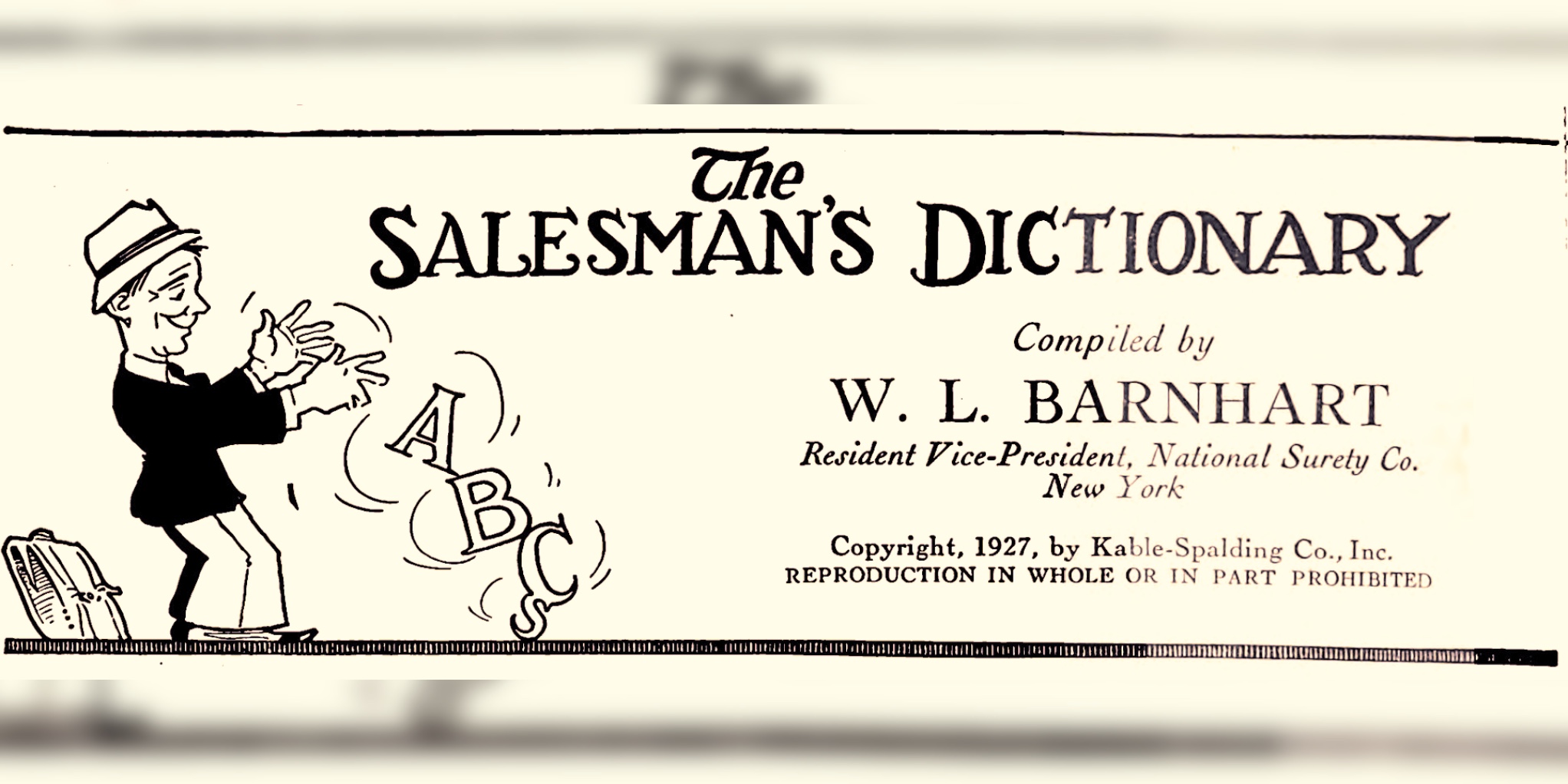
Starting in May of 1926, How to Sell magazine featured a series of articles called “The Salesman’s Dictionary”. Each month was another set. I highlighted my favorites from letters A through K in a previous article. Unfortunately, I haven’t been able to track down a few editions, so I’m missing L through O. But, it’s time to go through my favorites from P on today. What’s odd is, the final article of these appeared in the September of 1927 edition and at U. V through Z doesn’t appear anywhere. I have access to the October of 1927 edition through 1928. No finish…
Regardless, here’s my favorites of the many listed in these articles, with a little commentary for context.
PEP Letter or Ginger Letter – An exhortation to increased sales efficience. Often such letters have been made up of platitudes written by someone in home office without adequate conception of actual conditions in the field. Therefore “Pep” letters have generally come into disrepute.
In the early 1900s, sales leaders would send letters out to the reps in the field to motivate them, or teach them. Individuals like Worthington C. Holman had an incredible whole book of them called Ginger Talks (I have two different editions in my collection…1905 and 1909). In this set of definitions, clearly salespeople got sick of these things, feeling like they were largely irrelevant to what was actually happening in the field.
Personal Selling – Selling by direct contact with consumer of your goods. Contrast with telephone selling, mail selling and wholesale selling.
What most of us do today would be considered “personal selling”, or, engaging directly with the customer, face-to-face, versus over the phone, through catalogs, or through resellers / partners / retailers.
Pessimist – One who looks on the dark side of things. Pessimists never make good salesmen. They are also difficult prospects to sell.
Funny that they considered this to be a definition in the sales world?
Phrenology – A study that teaches mental faculties and traits of character are revealed by conformation of the head.
The study of the configuration of the head was a significant selling methodology 10-15 years earlier. Two keynote speakers at the 1916 World Sales Congress were noted phrenologists. Ford Motor Company subscribed to this approach into the early 1920s. The study of the shapes and the configuration of the head was believed to be a strong indicator of how you should approach and sell an individual. Wild.
Pre-Approach – Preparation for the sale, made in advance of actual physical approach to prospect. Includes finding out about prospect’s methods of doing business, personal habits and hobbies, and ways in which he can best use goods.
Every time I read somewhere that doing homework before approaching a prospect is a relatively new concept, I want to lose my mind. I believe more was done 100 years ago, with far less information and access than today.
Prizes – Rewards offered to salesmen who achieve unusual records or who surpass their fellow-salesmen. Prizes generally act as incentive to increased production by awakening salesmen’s desire to excel.
Another example of how little has changed in terms of approaches to compensation and extrinsic motivation in sales organizations.
Prospect, or Prospective Customer – The person, approached by salesman in hope that he may be persuaded to buy. Prospect generally refers to some one the salesman considers a logical or likely purchaser. Too few salesmen make enough distinction between “logical prospects” and mere “suspects”.
Psychological Moment – That period in sales interview when prospect can be closed most easily. Usually there are several psychological moments in every sales interview, and salesman studies human nature, so he can close at the earliest opportunity.
Much was taught around this concept of the “psychological moment” in the early 1900s. Salespeople were taught to understand when it was the right time to shut up, and when it was the right time to close.
Qualifying the prospect – Deptermining by questions that the man you are talking to is actually in a position to buy and could use your goods to advantage.
Qualification wasn’t a term oft used in books and other publications in the first quarter of the 20th century. Because getting in to see a prospect required so much effort, your homework was meant to ensure you weren’t using time speaking with a prospect to determine whether they’d be a good fit. You knew before you started.
Quitter – One who quits, or gives up, when things become difficult. Salesmanship is not a profession for quitters.
“Salesmanship is not a profession for quitters.” Well said!
Quota – A proportional figure assigned to each sales division. Total amount of sales desired for any given period is divided into quotas for each city or district, and sometimes this is again divided into individual quotas to be attained by each man. Quota for any salesman or district represents amount of sales those at home office believe should be secured in given period.
I’ve done an episode of The Sales History Podcast on this subject (Season 3, Episode 4) and have written a bunch on it. They did such a better job of setting accurate quotas back then. However, this description almost sounds like the way we’ve gotten ourselves into trouble with quota setting. Taking the “total amount of sales desired for any given period” then dividing it “into quotas for each city or district”, then dividing it again into individual “quotas to be attained by each man.” That’s the problem! Those doing quota setting right back then were setting well-researched, territory-specific quotas.
Reserve Talk – Additional sales points held in reserve for second interview or use after the first attempt to close. Salesmen should always hold a few good points in reserve so he can come back at prospect from entirely new angle.
This one cracked me up. It’s as though Barrett’s recommendation was to have a bag full of “sales points”. During the first interview, this suggests making sure you don’t empty that bag…keeping “reserve talk” sales points for the upcoming discussions, or to close the deal. Odd?
Ring the Bell – To be successful in single sale or selling in general. Derived from apparatus common at county fairs, where the hardest hitters, wielding a heavy mall, drive a weight up until they ‘ring the bell and get a good cigar.’
How great is this one? They rang the bell in 1927 for a closed deal. In each of my revenue leadership roles, we had a bell. Amazing that this is a tradition that goes back a hundred years.
Rut – A fixed, habitual way of doing things. Salesmen should keep out of ruts, because a rut only needs to become a little deeper to turn into a grave.
“A rut only needs to become a little deeper to turn into a grave.” What a great quote about not getting too comfortable in your own ways of doing things.
Salesmanship – The power to persuade people to purchase your product at a profit, according to the pioneer teacher of Salesmanship, A.F. Sheldon, who insists, however, that all parties, buyer, house and salesman, should profit.
Salesperson – One whose occupation is selling of goods or services.
Salesman – A man who sells.
Saleswoman – A woman who sells
Looking at these four above together, in quite a few publications before this set of definitions was published, authors would call out their use of the term “salesman” as including all genders. However, it’s interesting to me that these definitions are identified here, however, the term “salesman” is used in so many of the definitions.
Sample Case – 1. A bag or case in which a salesman carries samples of goods he is selling. 2. A magazine of salesmanship, organ of the United Commercial Travelers.
I have editions of the Sample Case Magazine in my collection dating back to 1903. The United Commercial Travelers is an associating going back deep into the 1800s, as a group supporting commercial travelers.
Shaking Hands – Most salesmen preface each sales talk by shaking hands with prospect. Others seldom do. It is largely a matter of inclination and sizing up the prospect; but if hands are shaken it should be wholeheartedly. No man likes a weak and listless grip.
Silence – Forbearance from speech. Salesmen should learn when to be silent and let prospect talk.
Split Commission – Commission divided between two or more salesmen who have worked together to consummate a sale.
Strong-Arm Selling – Selling in which salesman attempts to dominate buyer and browbeat him into signing order at once. Not to be recommended.
While not to be recommended, we saw a lot more of this type of behavior rising up in the 1920s. Stagnant inventories and idle machines were expensive, so many salespeople were hard-pressed to hard-press their prospects.
Super-salesman – Unusually efficient salesman. Term has been abused so much that it now brings a smile whenever mentioned, and so it is falling into disuse.
Swindle Sheet – Expense account of salesman on salary. Jocular expression doubtless due to supposed padding by such salesmen in expense items.
This one cracked me up. Adding a little padding to your expense report? As old as the profession…
Telephone Salesman – One who sells by talking with prospects over phone. Some organizations have made quite a success of telephone Salesmanship, and employee numbers of men or women to call prospect and give sales talk over the wire. It usually requires assistance of a personal “closer” to complete deals however.
So there you have it. We’ve filled in a bunch more letters through this look back at the commonly used words in the selling profession. Some have changed. Most haven’t. Any of these you’ll be incorporating into your selling vernacular going forward?

Todd Caponi, CSP® fell into sales and fell in love with the decision science and history behind it. He’s held multiple sales leadership roles, helping build one company into Chicago’s fastest-growing, another to an IPO and nearly $3B acquisition, and earning a Stevie Award as Worldwide VP of Sales. Todd is the author of The Transparency Sale, ranked by Book Authority among the best sales books of all time, and the award-winning The Transparent Sales Leader. His latest book, Four Levers Negotiating, was released on January 27th. He now speaks and teaches revenue teams worldwide and hosts The Sales History Podcast.
Reach out (email to info@toddcaponi.com) – for inquiries about speaking at your event or sales kickoff, for programs to upskill your customer-facing teams and leaders, or just to nerd out on sales or sales history.
And while you’re at it, sign up for the newsletter, which comes out every other week.




0 Comments