
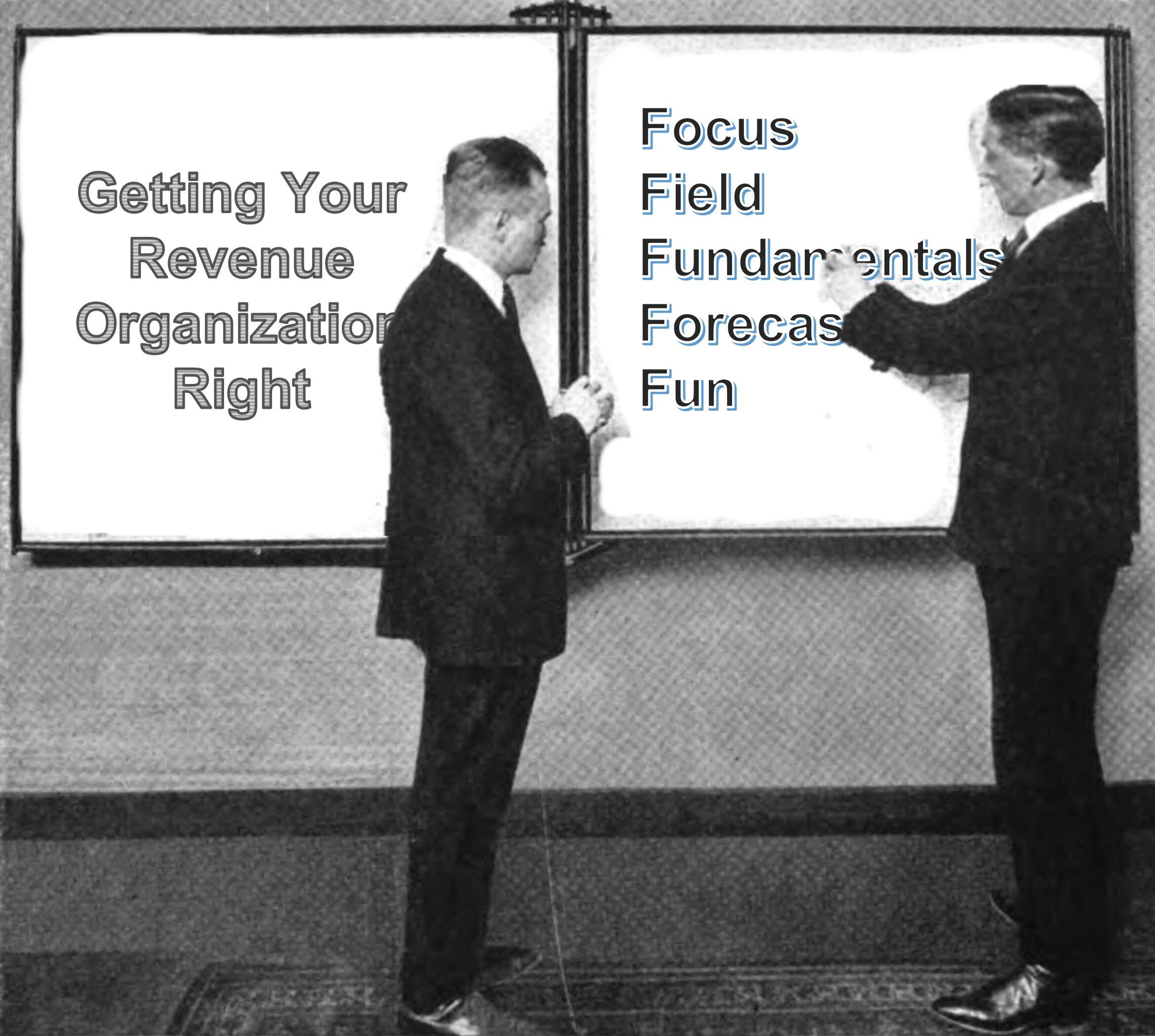
Getting Your Revenue Organization Right
Although I swore off doing “consulting” a few years ago, I’ve gotten a bit sucked back in. And, as much as I hate to admit it, I’m really enjoying it!
Through everything I’ve done to this point in my career, along with all of the research and studying of structures, behavioral science and history, there are core foundations in both structures and mindset that have proven over-and-over again to be what works.
As I’m working in a more sleeves-rolled-up manner with these organizations, the shift is palpable.
It starts with five core areas that, when optimized, organizations are able to plan, build and scale.
1) Getting your FOCUS right
We start here. The most valuable asset you and each of the members of your revenue team have that can be converted to revenue is their time. Is your entire revenue organization focused on working with the right companies (the ‘firmographics’), the right individual targets (the “demographics’), with the right pre-requisites (the details and traits of the organizations)?
When times get tough, organizations tend to try to cast a wider net of companies and individuals they target. I advocate for doing the opposite. Remember, every lead you target has a cost – time, resources and opportunity cost. Determine where have you found the greatest success, then overlay the commonalities amongst those successes.
2) Building and optimizing the FIELD to support that FOCUS
Next, we look at the team, the tools and the supporting resources. Do you have the right people in the right places with the right experience to best adhere to your FOCUS? We look at the tools the team is using, and the resources they have behind them to support their efforts.
We’ve gone through a period where turnover was rampant, tool acquisition was “let’s try everything”, and the combination resulted in less-than-optimal alignment between team member talent and what you and your organization truly needs to best tackle your optimal market. We also ended up with inconsistent tool utilization where adherence and output went down instead of up. Determine what tools and resources provide optimal outcomes for your FOCUS, not solely inward for your team.
3) Define and enable on the FUNDAMENTALS
As the FIELD takes shape, are those individuals getting the right things right consistently? These elements include the message being taken to the market in terms of your positioning and presenting. Discovery. Qualification. Formal presentations and demos. Negotiating. Executing the buying journey. Hand-offs to those who make purchases lead to outcomes.
Remember, we’ve had four different economies since January of 2020; the growth of early 2020 led to a shut-down economy in the spring. By the end of the summer of 2020, we were now in an extended “boom” time that lasted until Q2 of 2022. Now, we’re in the stagnant and potentially recessionary economy. Now, think about your messaging. When was it formulated? If it was during a different economy, delete it, and think about the value you provide TODAY.
4) FORECAST and measure
To appropriately plan, adjust and invest, you’ve got to be able to predict the future accurately, and measure the things that actually matter! First, think about the perspective you use when creating your forecast. Are you stages and categories based on recognizing buyer behavior? Or, are they based on the assembly-line of activities the seller is doing (qualify, discover, demo, promise, negotiate)? If it’s the latter, you’re probably have a hard time accurately predicting.
When thinking about what you measure, remember, there are only four things that contribute to results. These should be the header of trends and measures; 1) The number of qualified opportunities, 2) The size of each, 3) The win rate, and 4) The cycle length. Measure them as trends and measure them as ratios of each other…not in silos!
Do these things right, and you’ll be shocked at how much more accurate your forecast becomes, with a massive side benefit of becoming much more attuned to your customers. (Here’s an article with more…)
5) Cultivate a culture of FUN
If the team isn’t fully onboard with optimal levels of intrinsic inspiration, nothing else matters much. FUN isn’t about parties and cotton-candy, it’s about creating an environment where the team shows up every day, gives their best, stays, and becomes advocates for you leaders and your organization.
There’s a model I created that you can use to guide how you think about building the FUN in your team. It’s called The PRAISE Model. Predictability | Recognition | Aim | Independence | Security | Equitability. Maximize those, and it becomes the fuel for maximizing your revenue capacity.
These five elements comprise The Five F’s of Building Revenue Capacity: Focus, Field, Fundamentals, Forecast, and Fun. Now that you’ve got them, write them on a whiteboard in one column. In the second column, write down the current state of each with a little green, yellow, or red indicator. Which are in great shape? Which are ok? Which need real help? Then, in the third column, start identifying things you can do to move each into the green. (Here’s an article breaking down the PRAISE model with more details)
If you need help, you know where to find me. Call or text me at 847-999-0420. Shoot me an email to info@toddcaponi.com. Reach out via LinkedIn. Whatever…I’m happy to help.

I speak and teach revenue organizations on how to leverage transparency and decision science to maximize their revenue capacity. It’s what I do…teach sellers, their leaders, and really entire revenue organizations how we as human beings make decisions, then how to use that knowledge for good (not evil) in their messaging (informal and formal), negotiations, and revenue leadership. I wrote a 3x award-winning book (𝘛𝘩𝘦 𝘛𝘳𝘢𝘯𝘴𝘱𝘢𝘳𝘦𝘯𝘤𝘺 𝘚𝘢𝘭𝘦), and have a newish book out (𝘛𝘩𝘦 𝘛𝘳𝘢𝘯𝘴𝘱𝘢𝘳𝘦𝘯𝘵 𝘚𝘢𝘭𝘦𝘴 𝘓𝘦𝘢𝘥𝘦𝘳) now that just won its first award!
Sign up for the newsletter for more of my nonsense in your inbox every other week, with some sales history sprinkled on top…Sign Up – The Transparent Newsletter





0 Comments