
How to Get Sales Quotas Right – 10 Prescriptions from 100 Years Ago
I went down such a quota-setting sales history rabbit hole…I actually feel my anxiety and blood pressure rising.
Why? Because I just saw again a stat about how woefully low sales quota attainment is…and companies being happy when 35% of the team is hitting.
The quota attainment problem is fixable – with a prescription from 1925-1929. Yeah…seriously.
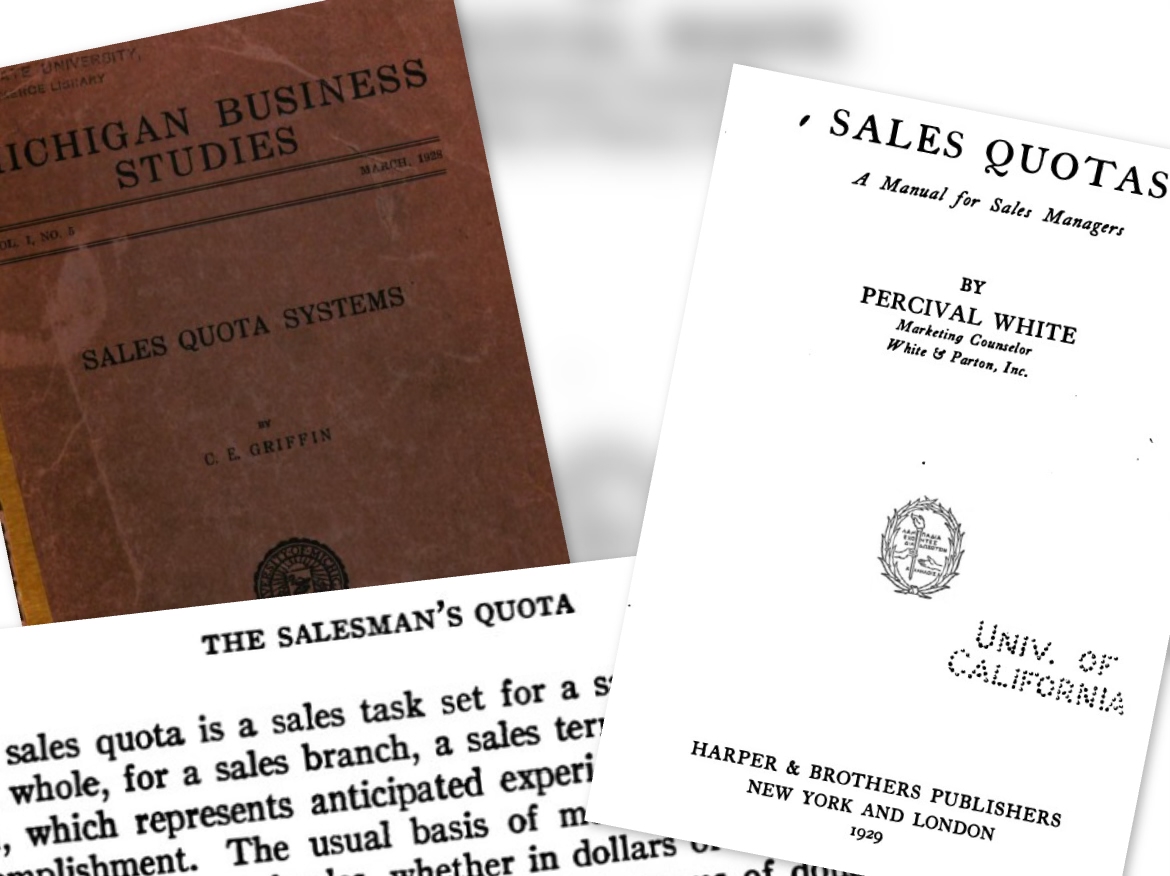
I ended up, for now, writing down ten prescriptions that Harry Tosdal in 1925, Clare Elmer Griffin in 1928, and Percival White in 1929 would have written for us today.
And I know – I sucked at this as a CRO myself! I’m not saying everyone is stupid here…but damn, can we learn some stuff from history. Like, I want to write a whole prescription here and work with a company or two to get it right…but I hate math!
1) Pick One Purpose For the Quota…Not Four:
The quota can’t simultaneously be your forecast, a compensation controller, a measurement of sales performance, and a motivator. Which is it gonna be? Pick one!
2) Calculate the Market Opportunity:
Not sure if you’ve heard, but there’s this thing now called Artificial Intelligence, or AI. How are we not able to calculate the actual market opportunity, by territory? They were doing it a hundred years ago without as much as an electric calculator.
3) Separate the “territory” from the “salesperson”:
When figuring out what a territory can produce, separate out market potential versus whether there’s been a talented salesperson there or not, who’s actually putting in the work or not.
4) Account for changing conditions:
Figure out how mature the market is, competitive pressure, pricing, your company’s investments in the product, marketing, etc. Again…use some AI, dammit! Sorry…sorry.
5) Use history as an input versus the calculation itself:
Stop it with the “last year +20%” bull(poop). They were making fun of this in 1929! What was done last year is interesting…and even valuable. But why did it happen? Did you have some fantastic sales yodaism going on? Maybe a couple of outlier deals?
6) Make the quota attainable:
All three of these 1920’s writers were banging the drum that the quota should represent credible expected performance, and incentives should encourage salespeople to exceed it.
7) Explain it, 1-on-1, to your salesperson:
You don’t have to explain every detail, but back then, managers would sit down with the reps and have a 1-on-1 conversation. “Here’s what we believe is attainable. Here’s why. Here’s the data.” I never did that. Have you?
8) Treat misses with diagnostics, not beatings:
A miss can’t be automatic irrefutable proof that your rep sucks. Maybe he or she does…but maybe the calculation was wrong, the regional economy has taken a hit, there’s a competitor focused more there than expected, or something else.
9) Continuously recalibrate:
Percival White wrote of how your quota system will begin imperfectly, but using what they had 95+ years ago, it gradually became “an instrument of considerable precision”. See above regarding friggin’ AI! It feels so doable…but maybe I’m not that smart.
10) Throw in a little common sense:
Griffin wrote that this data should be “aids to judgment” and supplemented by “a goodly admixture of common sense.” When we assign a quota and the rep looks at it and says to themselves, “I’m cooked”, we probably should have seen that first. You just buried that rep.
We have infinitely, unmeasurably, incomprehensibly more and better information, with a commensurate ability to actually crank through the data and make sense of it today.
***The three pieces are:
- Harry R. Tosdal, Principles of Personal Salesmanship
Published in 1925. Relevant section: “The Salesman’s Quota,” pp. 171–174. - Clare Elmer Griffin, Sales Quota Systems
Published in March 1928 by the University of Michigan School of Business Administration, Bureau of Business Research. Michigan Business Studies, Vol. I, No. 5. - Percival White, Sales Quotas: A Manual for Sales Managers
Published in 1929 by Harper & Brothers, New York and London.

Todd Caponi, CSP® fell into sales and fell in love with the decision science and history behind it. He’s held multiple sales leadership roles, helping build one company into Chicago’s fastest-growing, another to an IPO and nearly $3B acquisition, and earning a Stevie Award as Worldwide VP of Sales. Todd is the author of The Transparency Sale, ranked by Book Authority among the best sales books of all time, and the award-winning The Transparent Sales Leader. His latest book, Four Levers Negotiating, was released on January 27th. He now speaks and teaches revenue teams worldwide and hosts The Sales History Podcast.
Reach out (email to info@toddcaponi.com) – for inquiries about speaking at your event or sales kickoff, for programs to upskill your customer-facing teams and leaders, or just to nerd out on sales or sales history.
And while you’re at it, sign up for the newsletter, which comes out every other week.


0 Comments