

Is the Cost of Inaction Strategy Hurting Your Long-Term Revenue?
I’ve read the research. I believe the research.
“People are more motivated to avoid pain (loss) than to pursue pleasure (gain).”
Kahneman and Tversky

It’s called Loss Aversion, and it was masterfully researched and studied by Daniel Kahneman and Amos Tversky. I mean, Kahneman won a Nobel Prize for it in 2002.
And yet, when I deliver one of my programs (formal messaging/presentation choreography), I basically teach the opposite.
There is always someone who asks why. At a dinner in Florida a few weeks ago, someone purposely sought me out to discuss it. Just last week, I had someone tell me, “We’re taught to find the pain, then stick our finger in it and really root it out.” It’s the core of most selling approaches: identifying the prospect’s business pain, including the costs, risks, and consequences/costs of inaction. Root it out! (Sounds lovely, doesn’t it?)
Here are my two reasons for teaching the approach I do… and again, I have no Nobel Prizes. I just believe we may be applying Loss Aversion wrong in most selling organizations.
Burger King, Booze, and Health Saving Advice
If the avoidance of pain is twice as powerful as pursuing gain, then why do over 11 million people visit Burger King every day? Nobody walks in thinking, “This is good for me!” And, I’d argue most realize they’re going to feel pain from it. I have flashbacks from my last visit…the pain was both short and long term. (Sorry, Burger King fans!)
Why do people go out drinking all night knowing they’re going to feel horrible tomorrow? Why don’t people with life-threatening health issues flat not follow their prescribed healthy eating and exercise regimen? (Numerous studies discuss that only 20%-30% actually do!) What we’re selling isn’t life or death, right?
From a sales perspective, we know discounting isn’t good for us. It’s not good for our company. Having clients pay different amounts based on how well or poorly a negotiation was handled isn’t sustainable.
…yet many reading this probably gave discounts for nothing in the past 10 days.
I’d argue that many sales methods and approaches don’t account for loss aversion effectively. We sell that way, but we don’t act that way. Humans don’t avoid pain – we actually optimize for how we want to feel right now. Loss aversion works when the loss is immediate, personal, and inevitable. Create a short-term pain to avoid a long-term pain? We often prioritize other things…”Yeah, yeah, I need to do that.” Then we don’t.
The Repelling Nature of Guilt
I had a relative who, after I got married, always made me feel awful whenever we spent a holiday with her family instead of mine. “Oh, I won’t be here forever. You’re going to regret not spending every holiday with us!”
Did that make me want to spend more time with this relative, or less? Guilt doesn’t draw us in; it does the opposite.
So, I think about how salespeople are “rooting out the pain” and making customers feel guilty about not addressing it. Find the problem, put your finger in it, twist it around, make them uncomfortable. I don’t want to hang out with a person who’s doing that. Do you?
Seriously… who do you want to be in a long-term relationship with? Someone who:
- Constantly points out your flaws
- Magnifies your problems
- Is always trying to expose your pain
Or someone who:
- Helps you see what’s possible
- Guides you toward achievable outcomes
- Makes you the hero of a success story

Brian Regan
I mean, who wants to keep seeing their doctor? My favorite comedian, Brian Regan, says, (2:40 point in the video)
“Your doctor has carte blanche on insults. They just insult you for a while, and then you pay them for the insults on the way out.”
It’s like putting a snake on a table. We’ll draw back quickly…of course. But put $100 on the table? People will draw in.
The deal is no longer the peak of the selling engagement. You want customers to buy, stay, buy more, and advocate for you. I think wrongly applied “Loss Aversion” is much more likely to create avoidance, not affinity. And we need affinity in the feedback economy, where customers talk to their friends, are part of communities like never before, and word-of-mouth always wins.
How I teach
I have always believed that there are two ways to say any truth.
- If you don’t act, bad things will happen, or…
- If you address this, think of how great things will be
I believe in teaching the #2 approach, propping people up, helping others see what’s possible. Partially because those are the kinds of people i want to hang out with myself.
So, for any pain you’re trying to illuminate, teaching the possibility versus the cost of inaction might look like this. You can say…
“Your forecast inaccuracy is stunting growth. Investors hesitate, hiring stalls, and planning stays conservative.”
Or:
“Wouldn’t it be amazing to have a forecast everyone trusts so you can hire, invest, and plan with confidence?”
Same message. One deflates. One inspires.
You can say:
“With oncoming regulations, the burden you’ll face by not optimizing (whatever) is unsustainable.”
Or:
“With the oncoming regulations, wouldn’t it be awesome to have that box checked, while your competitors are all struggling with it?”
When everyone is a glass-half-empty, pain-amplifying rep, why not be the glass-half-full rep your customer wants to hang out with?
Loss aversion is absolutely real. But remember what Antonio Damasio said:
“We are not thinking machines that feel. We are feeling machines that think.”
We’re not as rational as we think. And, as humans selling to humans, those customers aren’t, either.
Pressure and guilt may help you close the deal, but attraction is what builds a long-term customer.

Todd Caponi, CSP® fell into sales and fell in love with the decision science and history behind it. He’s held multiple sales leadership roles, helping build one company into Chicago’s fastest-growing, another to an IPO and nearly $3B acquisition, and earning a Stevie Award as Worldwide VP of Sales. Todd is the author of The Transparency Sale, ranked by Book Authority among the best sales books of all time, and the award-winning The Transparent Sales Leader. His latest book, Four Levers Negotiating, was released on January 27th. He now speaks and teaches revenue teams worldwide and hosts The Sales History Podcast. 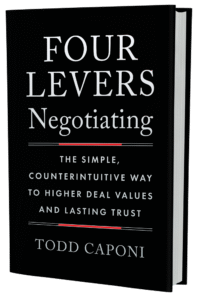
Reach out (email to info@toddcaponi.com) – for inquiries about speaking at your event or sales kickoff, for programs to upskill your customer-facing teams and leaders, or just to nerd out on sales or sales history.
And while you’re at it, sign up for the newsletter, which comes out every other week.



0 Comments