
Modern Price Discrimination – And How to Fix It
Are we practicing something today in sales that would be called “price discrimination”?
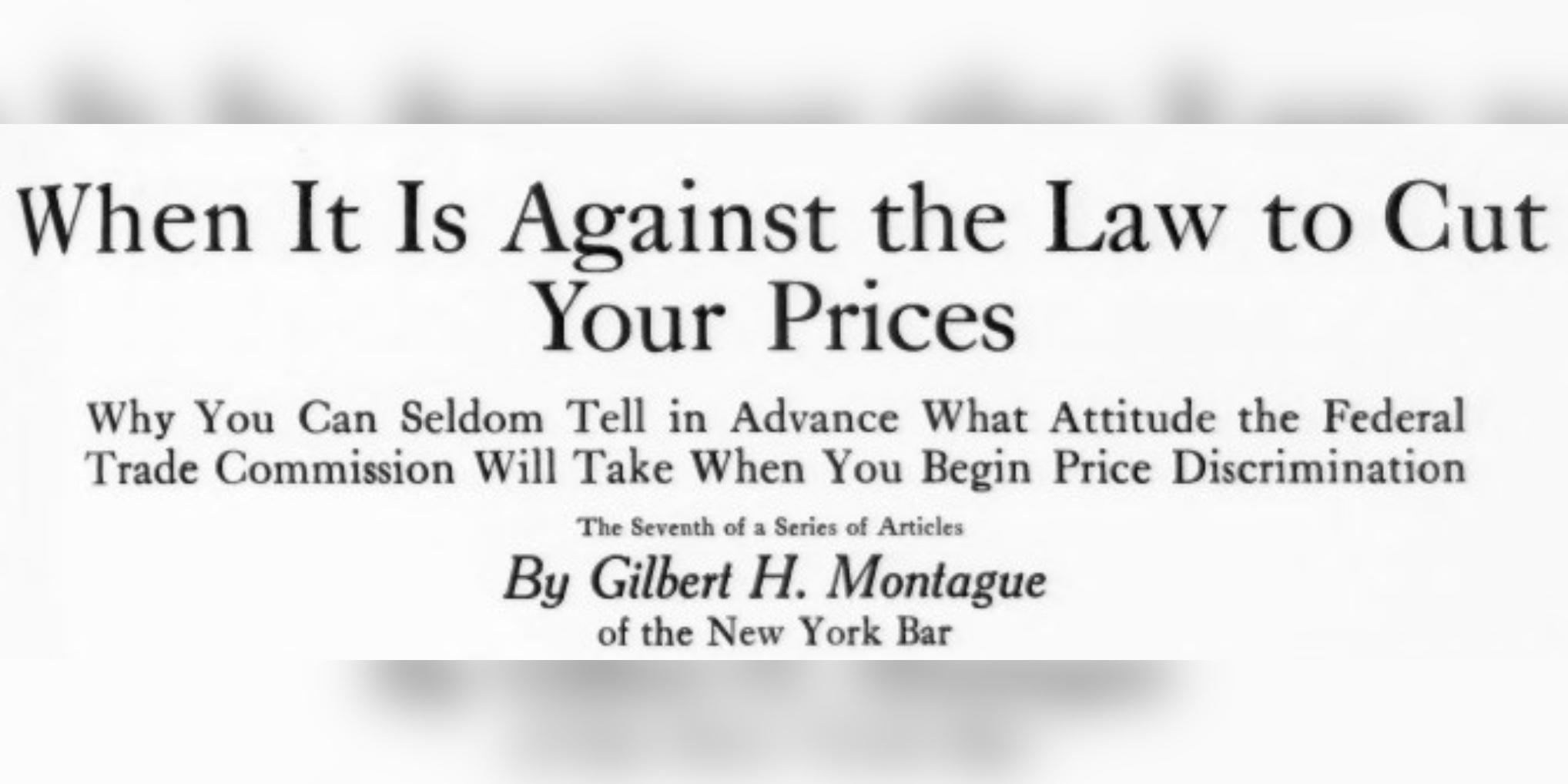
Reading a 1926 Sales Management magazine article titled “When It Is Against the Law to Cut Your Prices,” I was struck by how our lens on discounting has flipped.
The article focused on Section 2 of the Clayton Act, which addressed something they called “price discrimination”. Price discrimination simply means giving one price to one buyer and another to another. The purpose of the Clayton Act, however, was to protect businesses from larger manufacturers selectively cutting prices to lessen competition or create a monopoly.
As a salesperson, you were on high alert. Every time you were going to give one price to one buyer and another price to another, you documented exactly why…because you’d better be ready to defend it IN COURT. Because companies were sue-happy when they found out.
The article went through a pile of case studies, and helped readers understand when they were breaking the lawby answering questions like:
- Should a wholesaler get a different price than a retailer?
- Should a chain store receive a cumulative discount based on the purchases of all its locations?
- Should independent retailers who pool their orders get the same discount as a chain?
- Should customers buying the same quantity and quality of goods always receive the same price?
The courts generally allowed different pricing when there was a LEGITIMATE business bases behind it. A wholesaler might provide distribution services a retailer does not. A chain might create advertising value, more demand, or efficiencies through pooling that independents do not.
In other words, different pricing could be justified when the difference was tied to something real.
Fast forwarding to today, modern discounting in B2B looks like a different kind of price discrimination:
- Customer A pays list because they trusted us
- Customer B gets 20% off because it was the end of the quarter
- Customer C gets 15% off because they asked nicely
- Customer D gets 40% off because they were rabidly aggressive
Maybe we give a customer a better deal because they’re a big-name logo, or it’s something we justify through calling it a “strategic partnership”. We charge for some proof of concepts, we say no to others, and we give some for free.
“Can we defend this in court?” vs. “Can we defend this when customers find out?”
In 1926, this issue was about the law and about competition.
Would a price difference lessen competition? Was the discount based on a customer’s classification? Was it tied to the services performed, quantity purchased, transportation costs, or actual differences in something tangible?
The bottom-line question was: Could the company explain why one class of customers received different treatment than another? The pricing didn’t have to be identical, but it did need to be explainable.
Today, the law isn’t the problem.
But isn’t the court of public opinion a bigger risk? Customers comparing notes – connecting easily – and AI exposing it all?
Are you worried about that at all?
Without a sound basis, you’re slowing down your deals, too! There’s more procurement involvement, more asks, more skepticism around your pricing, more customers waiting until the quarter-end, and more margin leakage. Forecasts become less accurate, and your wallet doesn’t end up as full, either.
The Way Forward
This isn’t about being “anti-discount”. Discounts can make sense.
I’m probably biased, but we can fix this pretty simply… by creating a sound basis across the four levers of economic value:
- A customer who commits to more “Volume” should be paying less per unit than one who commits to less.
- And a customer whose “Timing of Cash” is faster than one who pays slowly…
- And a customer who makes a longer “Length of Commitment” than one making a shorter one…
- And a customer who is able to help you forecast the “Timing of the Deal”…versus one who drives your costs up through uncertain timing.
There is your sound basis. There is an opportunity for you to always feel comfortable when a customer asks, “Why did they get a better deal?”
It’s not being rigid, or saying “every customer must pay exactly the same amount”. You’re now exchanging value in a way you can defend easily. When a customer pushes, they can easily see that the deal is not random based on how well or poorly it was negotiated.
I think it’s quickly becoming a requirement…to go back to 1926 thinking, because the loudspeaker of pricing visibility is multiplying by the day.

Todd Caponi, CSP® fell into sales and fell in love with the decision science and history behind it. He’s held multiple sales leadership roles, helping build one company into Chicago’s fastest-growing, another to an IPO and nearly $3B acquisition, and earning a Stevie Award as Worldwide VP of Sales. Todd is the author of The Transparency Sale, ranked by Book Authority among the best sales books of all time, and the award-winning The Transparent Sales Leader. His latest book, Four Levers Negotiating, was released on January 27th. He now speaks and teaches revenue teams worldwide and hosts The Sales History Podcast.
Reach out (email to info@toddcaponi.com) – for inquiries about speaking at your event or sales kickoff, for programs to upskill your customer-facing teams and leaders, or just to nerd out on sales or sales history.
And while you’re at it, sign up for the newsletter, which comes out every other week.




0 Comments