

Sales kickoff best practices. Can they be found as early as the late 1800s?
The “modern” sales profession, as we know it, has been around that long. By “modern”, I’m referring to the idea of a singular corporation, hiring its own salespeople as full-time employees and training them in their own messaging and positioning. They pay them a salary-plus-commissions for what they sell. Those organizations have entire departments dedicated to sales, with sales managers. A rep works for one company only (versus the previous thousand years, where they were what we call today “manufacturers’ reps”, representing multiple companies’ products, commission only and independent). They are given dedicated territories on which to focus their efforts. They are a part of a team.

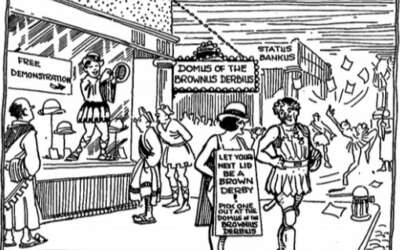
Pics like these are found sprinkled throughout my publications – this one from 1925, describing how sessions would always start on time – as showing up late a second time meant “a duckling in the camp pool”.
These late 1800s sales organizations had sales contests, conducted role plays (which they called “mock sales”), and hosted sales kickoffs (which they called “sales conventions”).
The foundations of our modern profession were based on what we all know to be true even today. The importance and value of their sales kickoffs were self-evident 135 years ago and should be looked at in the same fashion today.
My nerdery on full display, let’s look at the first sales kickoff…why it was created, what was required to make it a success, and what was prioritized. Then below, we’ll add a modern take on these lessons, as something you can hopefully use as a framework to optimize your own.
Lessons from 1887
The first known sales kickoff was held by the National Cash Register Company in 1887. Run by John H Patterson.¹
Without even realizing it, the majority of what we all practice today started with this one individual. Hiring, training, compensation and kickoffs all came from him. His disciples from the NCR Corporation went on to become the founders of countless other companies (including IBM), which sprouted more sales innovations.
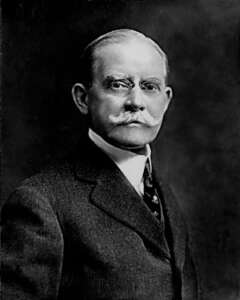
John H. Patterson, 1901
He had three core principles – which served as the guide for why sales kickoffs were so important to the success of his company, and any other in the modern selling era we still live in today.
1) “Right is right and wrong is wrong”.
Patterson, from Dayton, Ohio, loved to tell a story from one of the local shop owners in town. His name was Barney, and as he was inspecting a job that had just been finished, he turned to the carpenter who had done the job and asked, “seven times seven is forty-eight, isn’t it?”
“No”, the man answered.
“Well, then,” continued Barney, “you have made this pretty nearly right. Now go ahead and make it exactly right.”
“He wanted to teach them by example”, Patterson always said. “He wanted to show that everything had to be right, and he was the first man in Dayton who had first-class, up-to-date methods of doing business.”
Back then, all salespeople were remote salespeople. Sales “conventions” back then were required – to ensure that the message of the organization was the message being delivered to the customers. It had to be right. Exactly right.
2) The best way to teach is “by making us teach each other.”
In another story Patterson loved to tell, he spoke of an individual he referred to as “Old Man Bishop”. He was one of his professors at Miami University in Oxford, Ohio, where he attended school. Bishop would “point to one boy and ask him a question and he would answer the best he could. Then Bishop would point to another and another until finally the right boy had told the right thing. Then he would just smile and go ahead. That is the only way we knew that the right answer had been given.”
It was from Old Man Bishop that Patterson essentially invented the idea of having dedicated territories for salespeople. Without them, learning would suffer.
At a Patterson kickoff, “we bring all of you people together and we ask one person and another person to get up and talk, and then we ask for criticisms and suggestions. Now why do we do that? We couldn’t do that if we didn’t have guaranteed territories. You people wouldn’t be here to teach others to go into your territory and sell goods in your territory and get all the benefit of what you know. You would keep everything to yourselves. Guaranteed territory prevents all that and therefore you are able to come here and help each other.”
Teach each other. All boats are raised.
3) Learning from “small words and big ideas”
There’s no sense in acquiring “knowledge as knowledge” – he wanted everything to be applied. When Patterson was asked about his time at Miami University, and later graduating from Dartmouth, he said “What I learned was mostly what not to do. They gave me Greek and Latin and so on – all useless. I spent my vacation teaching school.”
“There I learned how to use small words and big ideas.”
Small words. Big ideas. Patterson believed this combination was key to learning, and the application of learning.
In other words, he didn’t want what is done today – department leaders attempting to break the PowerPoint land-speed record through departmental updates.
Patterson was not one who wanted the credit. He did not originate; he was all about drawing from others and drawing from outside NCR. For example, he would look at the Pyramids in Egypt not just as a world wonder, but to see what he could learn from them to use in his own business. He would go to a football game, then come back and give a two-hour talk about the value of teams.
He did not believe in the axiom “but my business is different”. There were lessons to be learned from others.
Sales Kickoff Foundational Elements Today
Get the fundamentals right. Learn from each other. Keep it simple. Amazing, when I think about it. All of the sales kickoffs I’ve attended, I’ve run, and now over the past four years keynoted or taught at, these concepts still bear the most fruit.
However, the one category that wasn’t fully understood 135 years ago was culture. The value of engagement, cultivating the intrinsic inspiration beyond just dollars that leads to top performance, extended tenure and the advocacy for the role that makes recruiting easier.
So, with that in mind, the best sales kickoffs today seem to focus on four key categories. To put it simply, they give their team CACE (I couldn’t find a word that started with “K”, so just pretend it’s “cake”…):
Celebrate: We, as human beings, do our best work when we are recognized for our efforts. Kickoffs are great opportunities to celebrate each other, our teams and provide the associated rewards and recognition.
Associate: We, as human beings, do our best work when we are part of packs. There is safety and security in being a part of a team, and knowing others have our back. It’s when our IQ is at its highest and our creativity flourishes.
Communicate: We, as human beings, do our best work when we are able to predict, and when our work matters beyond just our number. Uncertainty makes us crazy. Embrace the mission, the destination, the known and the unknown.
Educate: We, as human beings do our best work when we’re given the tools and resources to do our thing with the least amount of supervision. Enable the team. (as I’ve written about before, how education takes place matters! Learn the fine art of learning!)
Common to everything Patterson did is what I find so endearing to what he brought to the profession. He lived by this mantra:
“It pays to be honest, truthful, straight – to say what you mean and mean what you say.”
The key two words in that sentence, to Patterson, were “it pays”. All of his reasoning and every fundamental he taught was based on this idea.
Transparency sells better than perfection. It retains better. It grows better. And now, 135 years later, the proliferation of information, reviews, and feedback mean we have to do it anyway. Embrace this idea throughout your sales kickoffs. Make it a part of your culture. And (shameless, I know!) if you need help with the application, reach out. I’d love to help!
¹System Magazine, November 1923
Sign up for the newsletter for more of my nonsense in your inbox every other week, with some sales history sprinkled on top…
Sign Up – The Transparent Newsletter





0 Comments