
Sales Personas Throughout History and the Common Thread
Selling has been practiced for thousands of years. From the time of bartering in pre-civilization, selling was likely conducted in a skillful way throughout the centuries.
The deepest stamp of our current idea of selling is from around 1800 to the present day. Even more significant was the era of industrial expansion that followed the Civil War here in America.
Let’s take a look at the salespeople of the past 150 years as a study of how we should be thinking about selling today.
The Peddler:
In the early days of the first settlements, the peddler made their appearance, traveling from house to house, tribe to tribe, armed with a pack and riding a wagon. When commercial society was largely unorganized, the peddler performed a vital function in the distribution of goods.
Timothy Dwight discussed the peddler in his 1823 book, Travels in New England and New York, “…he wanders into the interior country; calls at every door on his way; and with an address, and pertinacity not easily resisted, compels no small number of the inhabitants to buy.”
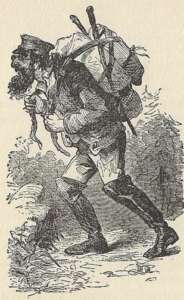
The Peddler, from a 1860 edition of Harper’s Magazine
Thomas Hamilton, found in a book by R. Wright in 1927 (Hawkers and Walkers in Early America), writing in 1833:
“The whole race of Yankee peddlers in particular are proverbial for dishonesty.”
The door-to-door salesperson has never been able to overcome this reputation established by these peddlers hundreds of years ago. Salespeople of this type have tried to convince their prospects that the irritating methods are not their own, but most people I know aren’t answering the door to find out.
The Drummer:
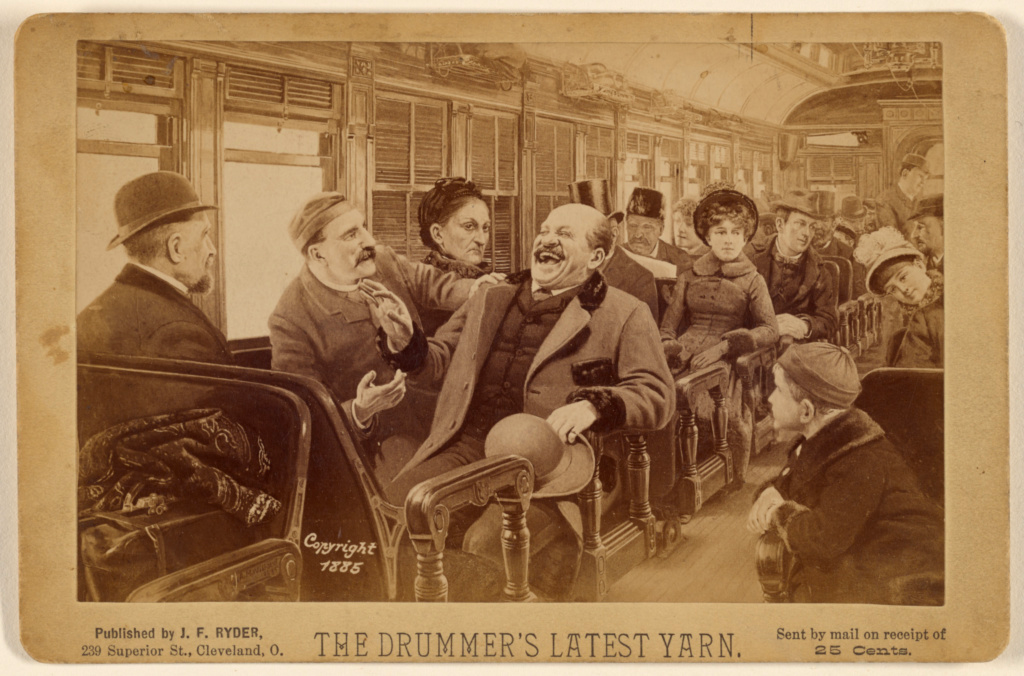
The drummer operated initially in large cities, extending their reach following the Civil War to everywhere. They were employed to wait at hotels or other places frequented by their potential prospects.
Edwin T. Freedley wrote in 1856 in his book Leading Pursuits and Leading Men, “Many jobbers keep one or more young men as drummers at each of the principal hotels, while most of the employees of their establishments do more or less service of this sort. They watch for customers as a cunning animal does for his prey.”
The drummer of the period 1840 to 1880 followed much the same approach as the peddler did a half century earlier. What’s interesting is how welcome the drummer was in town. Freedley goes on to explain, “Wherever he goes he is met with cordiality. Like all travelers he is full of anecdotes, and has at his command the rarest of news of the time. None are more glad to see him than the shopkeepers’ wives and daughters. To these he imparts the most recent scandal and the latest fashions, affording them subjects for gossip until his next visit to the town. To the tradesman he lauds his samples with all the eloquence and ingenuity of which hs is capable, and seldom leaves without making considerable bargains.”
Following the Civil war in 1865, the number of drummers in the United States grew from approximately 8,000 to over 90,000. A writer at the time discussed that, “…the commercial traveler must increase because more business is wanted, because the country is very rapidly developing and markets extending, and because it has been pretty thoroughly demonstrated that business cannot be as well done in any other way.”
In the 1931 book The Principles of Selling by H. Nixon, he wrote:
“To their generation the drummers were a romantic crew. In the backwoods and frontier communities these strangers from the cities, with their urban polish, their black cigars, their doubtful morals, their collection of piquant stories, and their persuasive manners made a deep impression. Legend grew up about them. They came to stand in the public mind as symbolic of a certain type of selling – selling based upon personal appeals, entertainment, gifts, exploitation of passion and weakness.”
Following 1900, the “drummer” became known solely as a commercial traveler, given their customers no longer needed them for entertainment or news.
P.T. Barnum and the Confidence Man
Selling often became a battle of wits, as recognized during the Roman Empire through the term, caveat emptor, or let the buyer beware. Nobody symbolized this idea more than P.T. Barnum, whose philosophy was that of a trickster. His reputed slogan was, “There’s a sucker born every minute.”
Early retail transactions were represented by an absence of fixed prices. Many retailers were known to toss a little sand in the sugar to increase the weight, or a little chicory in the coffee. In the 1923 book, Barnum, he himself is quoted as saying, “Our cottons were sold for wool, our wool and cotton for silk and linen; in fact, nearly everything was different from what it was represented. The customers cheated us in their fabrics; we cheated the customers with our goods. Each party expected to be cheated, if it was possible. Our eyes and not our ears had to be our masters. We must believe little that we saw, and less that we heard.”
“Commercial morality was at a low ebb”, according to Nixon in his 1931 book, describing part of the period from 1860 to 1900. He added that “the philosophy of the times was one of exploitation. Business was ruthless and frequently unscrupulous. Selling methods merely reflected the temper of the people.”
This led to the emergence of another type of salesperson, the confidence man. They were well dressed, impressive looking, a smooth talker, and careful to be both unscrupulous but within the law. They sold worthless stock, patent rights, gold bricks and other items not worth their cost.
The High-Pressure Salesperson
Eventually, we arrived at a place that still defines what most people think of when they think “salesperson”. The Industrial Revolution took place. This led to the development of machines that could produce large quantities of products. The country was also undergoing a massive expansion, including the opening of the West, so manufacturing was essentially meeting demand. Eventually, the machines were producing more products than the market needed, and idle machines are expensive. Advertising spend went up. Training salespeople to be assertive increased. And the theme for the best salespeople were the ones who could “make them buy”.
“By his dominating methods, he left a trail of irritation behind him, so that his work became harder and harder.” – Nixon, 1931
The Service Mantra
There were some retailers trying to throw out the old ideas of the peddlers, drummers and confidence men as early as 1842. Some New York stores were advertising published pricing, one price for all, which was revolutionary versus the way everyone had been taught to haggle and bargain.
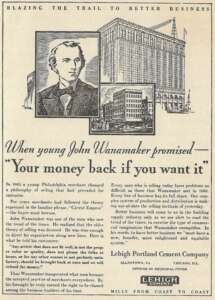
Wanamaker ad from 1865 advertising the money back guarantee.
It was that year that Cyrus Hall McCormick, who invented the reaper, gave a written guarantee with each one.
John Wannaker had adopted the same policy in his Philadelphia store…a return or money-back guarantee. They pointed the way towards the new concept of selling, which was expressed in a single word: service.
As the 1800s came to a close, the country was becoming more settled. Trade had been established, education standards were growing, and business ethics needed to coincide with economic order. The GOAT of sales philosophers, Arthur Sheldon, published the first known public course. Many others followed.
“True salesmanship is the science of service. Grasp that thought firmly and never let go.” – Arthur Sheldon, The Art of Selling, 1911
H.K. Nixon, in his 1931 book Principles of Selling, has some profound things to say about the eras of selling.
He starts with this quote:
“One of the most significant changes in the selling theory of our day is the gradual disappearance of what may be called the philosophy of exploitation. This theory assumed that the sole aim of selling was to secure the immediate disposal of goods and the greatest possible profit, without regard to the needs or wants or desires of the buyer. It originated in the cruder economic life of the past when the struggle for existence was more an individual matter and where the weak and ignorant customer had little opportunity to fight back.”
He added:
“the man or woman going into selling today has to choose between the older definitions which thought of salesmanship as the art of making people buy and the more modern concept which considers selling as the business of helping people buy.”
And there was one simple moral…which has guided the profession since its original existence as far back as humans roamed the Earth.
“The selling methods of any period grow out of the economic situation of the time.”
There are always laggards, where old school methods persist in isolated spots or in specific industries. However, the majority of the profession has consistently been found to progress in step with the macro environment.
Today, “the weak and ignorant customer” is few and far between. They are no longer powerless to fight back. With reviews on everything we do, buy, and experience pervading all things large and small, the ability to connect with peers not only across the street, but across the globe, and the virality of bad experiences and actors in business and beyond, the majority of true professionals have shifted to a theory of customer conservation.
Wilbur Hall wrote in his 1921 book, The Salesman’s Kindergarten:
“It isn’t enough nowadays for a salesman to wear a ninety-dollar suit and carry a half a dozen Havana cigars in his vest pocket. He must have something above the collar besides a pleasant smile and an easy delivery.”
It’s natural and human to be drawn towards the selfish satisfaction of our own wants and desires. It’s unreasonable to expect salespeople to forget themselves and their own wallets. It’s showing the salesperson that being far-sighted does not mean being altruistic or philanthropic; it serves the same purpose. The short-game wins the short-game, but also wins the long game in the feedback economy. It’s far simpler today to educate customers and then give them what they want, rather than trying to force or convince them against their better judgment.

I’m Todd Caponi, CSP®. (<– links to LinkedIn)
I’ve written three books so far, The Transparency Sale, The Transparent Sales Leader, and my soon to be released Four Levers Negotiating.
I’m a sales keynote speaker and sales trainer, focused on teaching revenue organizations how to leverage transparency and decision science to maximize their revenue capacity.
It’s what I do…teach sellers, their leaders, well…entire revenue organizations how we as human beings make decisions, then how to use that knowledge for good (not evil) in their messaging (informal and formal), sales negotiations, sales presentations, and revenue leadership.
Reach out (email to info@toddcaponi.com) – for inquiries about speaking at your event or sales kickoff, for programs to upskill your customer-facing teams and leaders, or just to nerd out on sales or sales history.
- Sign up for the newsletter, which comes out every other week.
- Sign up to get on the launch list for Four Levers Negotiating.
- Pre-Order Four Levers Negotiating right now (releases January 27th, 2026), or reach out for bulk orders (> 10)





0 Comments