

The Differences Between Four Levers Negotiating and Never Split The Difference
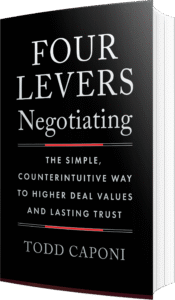 As you may be aware, I’m releasing my new book, Four Levers Negotiating, on January 27th of 2026. You may also know that I don’t read many current books, as I’m a nerd for the history of the sales profession. I feel like almost every book today has been written a hundred times over the past 120 years.
However, one book I absolutely did read and actually really enjoyed is Never Split The Difference by Chris Voss. It combines three of my favorite things: (1) Behavioral Science, (2) High-Stakes Drama, and (3) Sales. The stories are incredible. And, given that I have older books on negotiating in my collection, this one is the best I’ve ever seen for high-stakes negotiations. 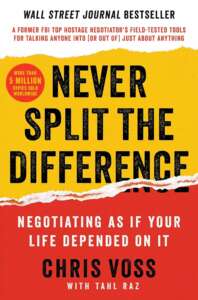
If a great, current book on negotiating already exists, why would I write one?
Growing up in sales, I couldn’t execute in that context. I’m not built for negotiating international peace treaties or negotiating to save lives. My perspective on the current state of the world of sales, in my (clearly biased) opinion, requires a different approach to business-to-business negotiations. A transparent one. A trust-building one.
Want to know the differences between Four Levers Negotiating and Never Split The Difference?
1) The Context
I always felt it strange that I needed to take on a different personality when it came time to negotiate, versus the one I used during the sales process.
The foundation of the sales profession is based on service – guiding the customer to achieve optimal outcomes, possibly even outcomes they never thought possible, as quickly as possible…even if that means recommending an alternative solution.
However, once the customer says “yes”, we’re learning techniques designed for high-stakes, adversarial engagements like those found in hostage negotiations.
In today’s economy, the sale itself is no longer the peak of the selling engagement like it may have been in the 1900s. It’s merely an early milestone on the path to having customers who not only to buy, but also to stay (i.e., renew), buy more, advocate to their peers, and even take us with them to their next role.
And, with the proliferation of feedback, peer connection, and even AI, if every customer is paying a different amount based on how well or poorly the negotiation went, that’s a race to eroded trust, and ultimately the bottom.
Four Levers Negotiating is the opposite of adversarial. It’s cards face up. It’s not designed to be inflexible; it’s intended to establish a sound basis for your pricing, while giving your customers the levers to negotiate their own transactions.
2) The Tone
Imagine a bank heist, where the perpetrator has taken ten hostages. When considering the title, Never Split The Difference, the idea is that you would never recommend to the perpetrator that they release five of the hostages, then go ahead and kill the other five. That would be insane. The goal of the negotiation is to influence the safe release of all ten hostages, while also removing the perpetrator’s ability to harm others.
The subtitle of the book is “Negotiating As Though Your Life Depended On It”. I struggle with how that could be a good mindset to enter a business-to-business negotiation, especially at the threshold of a transaction.
Negotiating a business-to-business transaction shouldn’t feel like a battle. And remember, you don’t get to tase the customer and drag them to jail once the transaction is complete. You need them to stay, buy more, and be a long-term advocate for you and your solutions.
3) Word Art vs Structure
Maybe the term “word art” sounds harsh versus defining it as “tactical communication”, but to effectively, consistently, and with scale implement Never Split The Difference, it requires your ability to know exactly when to apply the techniques like “mirroring”, “labeling”, and “calibrating questions”.
For example, mirroring is the idea that when a customer makes a statement, repeating the last 1-3 critical words psychologically causes most to expand without feeling like they are being interrogated. It’s a concept that goes back to the 1950s, and is brilliant.
However, (a) it takes a lot of practice to get good at it. Knowing exactly when to use it. Knowing what the critical word or words are to mirror. And (b) it’s a psychological trick. Even Voss jokes in his own book about someone using the technique in a conversation with him, referring to it this way: “Keenon had been playing with me the entire time…”. Playing with me? If you’ve read my first book, The Transparency Sale, you know I’m all for understanding psychology – using it for good, not evil. I often feel as though the “psychological tools” are not used for good as much as they’re being used to win.
Four Levers Negotiating presents a simple, structural framework for how you position, propose, and negotiate the commercial terms of an agreement. They’re designed to be shared openly as a guide to the negotiation, versus any attempts to manipulate it in your favor.
4) Transparency versus Leverage
Voss is an advocate for strategic disclosure and conceals information if it improves leverage. Again, this makes absolute sense when lives are on the line, and the completion of the negotiation is likely the last time you will be interacting with the individual. Chapter 7 of the Never Split The Difference book is titled “Create the illusion of control”. My transparent nerdy sense tightens up whenever we’re learning anything about creating an “illusion”. That’s a form of lying, and the opposite of transparency to me at least.
In Four Levers Negotiating, I’m advocating for establishing a sound basis for your pricing through teaching your customer your business model and pricing structure. Your pricing is based on four things:
- Volume, or how much they buy…products, technology, services, users, etc. Committing to more is better than committing to less.
- Timing of Cash, or how fast they pay. Paying faster is better than paying slower.
- Length of Commitment, or how long they commit to the products, technology, and services. Longer commitments are better than shorter ones. And,…
- Timing of the Deal, or a mutual alignment around when they intend to sign and implement. The ability to forecast is highly valuable.
That’s all. The price is the price, but those four elements are what you are willing to pay for in the form of a discount: buy more, pay faster, commit longer, and help us forecast.
5) Application Environment
Voss’s approaches are so valuable in many circumstances, but originate in crisis and personal negotiations.
Four Levers Negotiating is born in the B2B sales environment, and specifically where long-term customer success matters more than the individual win.
I may be biased, but I’ve heard it from so many that I’ve taught over the past 15+ years: it’s head-slappingly easy. You’ll learn it, be able to use it that afternoon, and you’ll often see results immediately…results like less discounting, higher deal long-term values, more accurate forecasting, and trust that’s built through the goal line instead of eroded. And, when your customer leaves for another organization and takes you with them, they’re not taking all your discounting baggage with them, too.
Again, don’t sic Voss on me. If we went head-to-head in a negotiation, he would crush me like a grape. The intention of Four Levers Negotiating is to make negotiation feel like an extension of the sales cycle, where trust is not only maintained, but it grows. It’s designed to make discussing and negotiation not feel like an anxiety-ridden step. It’s authentic. It’s transparent. Additionally, it results in significantly less discounting and a more accurate forecast.
(You can pre-order it wherever you buy your books. Here’s a link that links to several retailer sites for the book. So much more to come…)

My name is Todd Caponi, CSP® I’m a sales keynote speaker who also teaches revenue organizations how to leverage transparency and decision science to maximize their revenue capacity. It’s what I do…teach sellers, their leaders, well…entire revenue organizations how we as human beings make decisions, then how to use that knowledge for good (not evil) in their messaging (informal and formal), negotiations, and revenue leadership. I wrote a book Book Authority had listed as the 6th best sales book of all time (𝘛𝘩𝘦 𝘛𝘳𝘢𝘯𝘴𝘱𝘢𝘳𝘦𝘯𝘤𝘺 𝘚𝘢𝘭𝘦), and a second award-winning book (𝘛𝘩𝘦 𝘛𝘳𝘢𝘯𝘴𝘱𝘢𝘳𝘦𝘯𝘵 𝘚𝘢𝘭𝘦𝘴 𝘓𝘦𝘢𝘥𝘦𝘳).
Coming out on January 27th, 2026, is my third book, Four Levers Negotiating. Pre-Order it now! 🙂 For more information on the book or to follow along, check out the 4LN landing page here: https://toddcaponi.com/four-levers-negotiating/ 
I’m already booked for a few revenue kickoffs as a keynote speaker (and workshops along with them) in January and February, but would love to discuss yours. Reach out… Email info@toddcaponi.com or call 847-999-0420.
Sign up for the newsletter for more of my nonsense in your inbox every other week, with some sales history sprinkled on top…Sign Up – The Transparent Newsletter




0 Comments