
What is a good revenue leadership framework?
Frameworks. I’ve always been all about them, because otherwise, in every instance without one, I found myself feeling like a dog chasing a car down the street. I never knew where it was headed…I just knew I had to chase it.
Aside from sales and revenue leadership, what makes a good “framework”?
In my opinion, a good framework provides a structured way to solve a problem, establish a system, and/or allows you to see the entire picture of something without being too restrictive.
For me, when I first moved into sales leadership, I went from having a sales process and structure to now not having much of anything. I certainly had never been taught anything about sales leadership. And, sure enough, a couple of days into my tenure, I felt my hair catching on fire.
I sat with myself in front of a whiteboard and created a revenue leadership framework for myself. That was eighteen years ago. Since then, I’ve optimized every element, using behavioral science, trial and error, and observational experience. I then laid it on a bed of transparency, and the results were…
- I sounded really smart…and I could use all the help I could get
- We maximized the revenue capacity of our teams, consistently
- We had a consistent way to communicate up, down, and side-to-side with each other
- I used it for everything, from a 1-on-1 agenda with my reps and my boss, to as I moved up, it became the agenda for my 1-on-1s with my leaders, and even my section of board meetings.
So, what is a revenue leadership framework?
It’s a structure centered around all of the responsibilities that a revenue leader is responsible for, which also happen to be the elements that, when optimized, maximize the revenue capacity of your teams.
I quickly realized that all of my responsibilities fall into one of five buckets. I made them alliterative because, as a dummy, I wouldn’t remember them otherwise.
They became the Five F’s of Maximizing Revenue Capacity. They apply to every revenue leadership role, whether it’s overall revenue as a CRO, as a sales leader, client success leader, business development leader, or marketing leader. It applies to every level within them, from front-line to a leader of leaders.
It also applies if you’re new to the role, have been there a while, building a team, fixing a team, scaling a team, entering a new market, focused on improving retention, building demand, or whatever the responsibility of the day might be.
The Five F’s of Maximizing Revenue Capacity
All of your responsibilities, as a revenue leader, fall into one of five categories. Internalize them, and you’re already 98% ahead of the leadership world that has no framework or structure.
1) Focus
As a revenue leader, your first and ongoing responsibility is to make sure your team is using their most valuable asset, their time, on the right things. Are they spending their time on the right clients? That includes the right firmographics (verticals, sizes, geographies), demographics of the individuals within those firmographics (roles, levels, responsibilities), and prerequisites (their existing environment, triggers, or other corporate priorities).
This goes beyond having an “ICP”, which is the Ideal Customer Profile. Your responsibility is to hone that focus, establishing and then ensuring that time is well spent. (I used to call my approach my “no science projects” policy).
You determine, then have the discipline, of deciding where your team should and should not spend their time.
2) Field
As a revenue leader, are we putting the right team on the field every day, with the right tools, and the right resources? In other words, this is your people, your systems, your organizational design, your coverage, and your support.
Thinking about the questions like, based on your “focus”, like:
- Do we have the right people with the right experience in the right places? This responsibility includes your recruiting responsibilities.
- Do they have the things they need to be effective? Are the tools we have helping them, distracting them, and/or helping us achieve optimization?
- Do they have the support they need to be effective?
A big part of revenue leadership is ensuring that your “Field” is built to execute your “Focus”.
3) Fundamentals
As a revenue leader, you have to make sure that your “Field” is getting the right things right, consistently. What are the things you need your team to be able to repeatedly do optimally?
For the sales functions, those are things like prospecting, qualification, discovery, positioning, messaging, presenting, demoing, negotiating, managing opportunities, managing their time, etc.
In client success, that might be things like onboarding, solution adoption, renewal conversations, identifying expansion opportunities, and engaging with executives.
In sales development, you’ll be considering research, outreach approaches, and handoffs.
Marketing is trying to optimize segmentation, messaging, executing campaigns, managing leads, measuring…
I could go on forever here, but the point is that revenue leaders must ensure that their team is consistently doing the things that produce optimal outcomes.
4) Forecast
Surprise, surprise! As a revenue leader, an important part of your responsibility is predicting the future. That’s not just forecasting, but also understanding the metrics / key performance indicators that contribute to the results.
In sales, this is pretty obvious, right? Being able to forecast accurately also requires establishing the culture and organizational behaviors that enable you to see what is likely to happen before it happens.
But that also applies to client success leadership: understanding the leading indicators and helping the team understand those things, too. Customer engagement. Renewal rates.
Sales development is using activity, deal qualification, and pipeline creation. Marketing is using campaign performance, MQLs, or whatever.
Revenue leaders must be like meteorologists, only better. In other words, they’re never expected to be 100% accurate, but if they’re not within a standard deviation, trouble will be brewing.
5) Fun
A core responsibility of revenue leadership is establishing a culture where teams are intrinsically inspired to show up every day, stay, put in their best effort, and become advocates to others for the company and the role.
In other words, “Fun” isn’t about parties, ping pong tables, and a snack-packed breakroom. It’s the environment you create, where a team feels that they can Predict what they’re getting themselves into each day, are Recognized/given feedback for the work they do, where the Aim of their work is bigger than just hitting a number, where they feel a level of Independence to do their best work with minimal oversight, where they feel the Security of being a part of a pack where others have their back, and the Equitability of feeling things are fair, lack politics, and the juice is worth the squeeze.
In other words, revenue leaders who maximize P.R.A.I.S.E. create environments where discretionary effort is maximized, turnover is low, and time to recruit is quick.
Focus | Field | Fundamentals | Forecast | Fun
“Hey, Todd, what about coaching? Where is it? I’m supposed to coach, right?
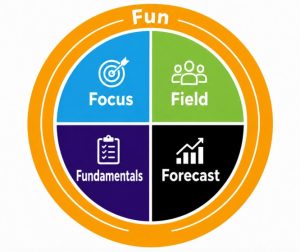
The Five F’s – Focus, Field, Fundamentals, Forecast, all encircled by Fun
Of course. The point of the framework is to establish the structure. Step one is assessing where you are in each element, down to the individual level. You can’t coach until you know what to coach on! Coaching overarches every single element of the Five F’s framework.
You coach your team on their Focus. You coach your team on the Field elements of tool and support utilization. You coach your team on the Fundamentals. You coach your team on the Forecast, the deals, but using the metrics and their relationship to one another. You coach your team on Fun, meaning the things that contribute to their engagement.
Internalize the Five F’s, and the world of revenue leadership immediately slows down. You’ll see the holes before they form. You’ll maximize the capacity of your teams. And you’ll sound really smart, too!
Oh, and for those interviewing for revenue leadership roles, having a framework will set you apart from every other candidate. I believe it’s quite literally how I got my last Chief Revenue Officer role. The CEO had interviewed thirteen candidates before me. I got the offer the next day.
So, what makes a good revenue leadership framework?
A common language. A consistent structure. A comprehensive way to see all of your responsibilities. Something that’s easy, where everyone can start using it.
Mine here is just the one I built and used. I’d never have made it by chasing cars down the street all day…
*** I teach this program to revenue leadership teams. It’s a multi-part, choose-your-own-adventure program where you learn the framework, then, depending on your priorities, we deep dive into individual elements. I also teach it cohort-style in partnership with Sales Assembly.
*** My second book (of three), The Transparent Sales Leader, lays all of this out. Get it wherever you get your books, in all formats.

Todd Caponi, CSP® fell into sales and fell in love with the decision science and history behind it. He’s held multiple sales leadership roles, helping build one company into Chicago’s fastest-growing, another to an IPO and nearly $3B acquisition, and earning a Stevie Award as Worldwide VP of Sales. Todd is the author of The Transparency Sale, ranked by Book Authority among the best sales books of all time, and the award-winning The Transparent Sales Leader. His latest book, Four Levers Negotiating, was released on January 27th. He now speaks and teaches revenue teams worldwide and hosts The Sales History Podcast.
Reach out (email to info@toddcaponi.com) – for inquiries about speaking at your event or sales kickoff, for programs to upskill your customer-facing teams and leaders, or just to nerd out on sales or sales history.
And while you’re at it, sign up for the newsletter, which comes out every other week.




0 Comments