
What is the biggest change to sales / business going to be over the next 5 years?
I was asked this question during a podcast interview earlier today. My answer was a bit of a reframe of the question first.
“Aside from the obvious? I believe AI is about to expose how companies price similar deals differently. It’s already happening. That is going to force those companies to replace arbitrary discounting with economically defensible, consistent, and more logical approaches to negotiating.”
I’m pretty sure I didn’t say it as eloquently as I just wrote it, so here’s a simpler way to say it. I believe businesses are going to have a really hard time having each of their customers paying a different amount for essentially the same solution because of:
- How well or poorly the salesperson positioned and negotiated the pricing and commercial terms
- How aggressive and savvy the buyer and their procurement team approached the negotiation
- How much quarter-end pressure the vendor is under at the time of the negotiation
- Inconsistent approval processes within the vendor where certain leaders are more willing to bend than others
- What the buyer paid for the vendor’s solutions at their last company
I believe AI is creeping towards a world where customers will eventually have visibility into the prices and terms customers are getting with different vendors. It’s already happening outside of AI. Peers are connecting with one another already, and I’ve heard of events, specifically at a cyber conference, where CISOs (Chief Information Security Officers) were getting together talking about vendors, what they’re paying, what they asked for, and what they received.
Don’t we think AI is going to have that information soon?
How can irrational price differences not be explainable? How can businesses sustain margins, defend against a race to the bottom, and, not to mention, maintain trust, where the better negotiators are getting markedly better deals than those who take you at your word and don’t aggressively negotiate?
Is your organization ready? If you were asked, right now, why your Customer A is paying 20% less than Customer B for a materially similar solution, would you have a good answer that doesn’t blame the salesperson, the quarter timing, or the customer’s ability to negotiate?
I don’t believe the answer, or the future of pricing, is simply “one price for everyone.” Instead, the answer is a defensible structure for how you discuss, propose, and negotiate pricing, and price opacity will no longer protect the irrational differences.
There are two steps I’d suggest taking right away.
Step One – An Informal Audit:
- Pull your agreements, and begin to identify your customers who have similar configurations
- Compare what they are actually each paying
- Identify and account for payment terms, contract duration, volume, services, and support
- Flag the differences that can’t be economically explained
- Review whether your sellers are exchanging concessions for true value, or just giving discounts
Step Two – Establish Acceptable and Defensible Exchanges Through the Four Levers
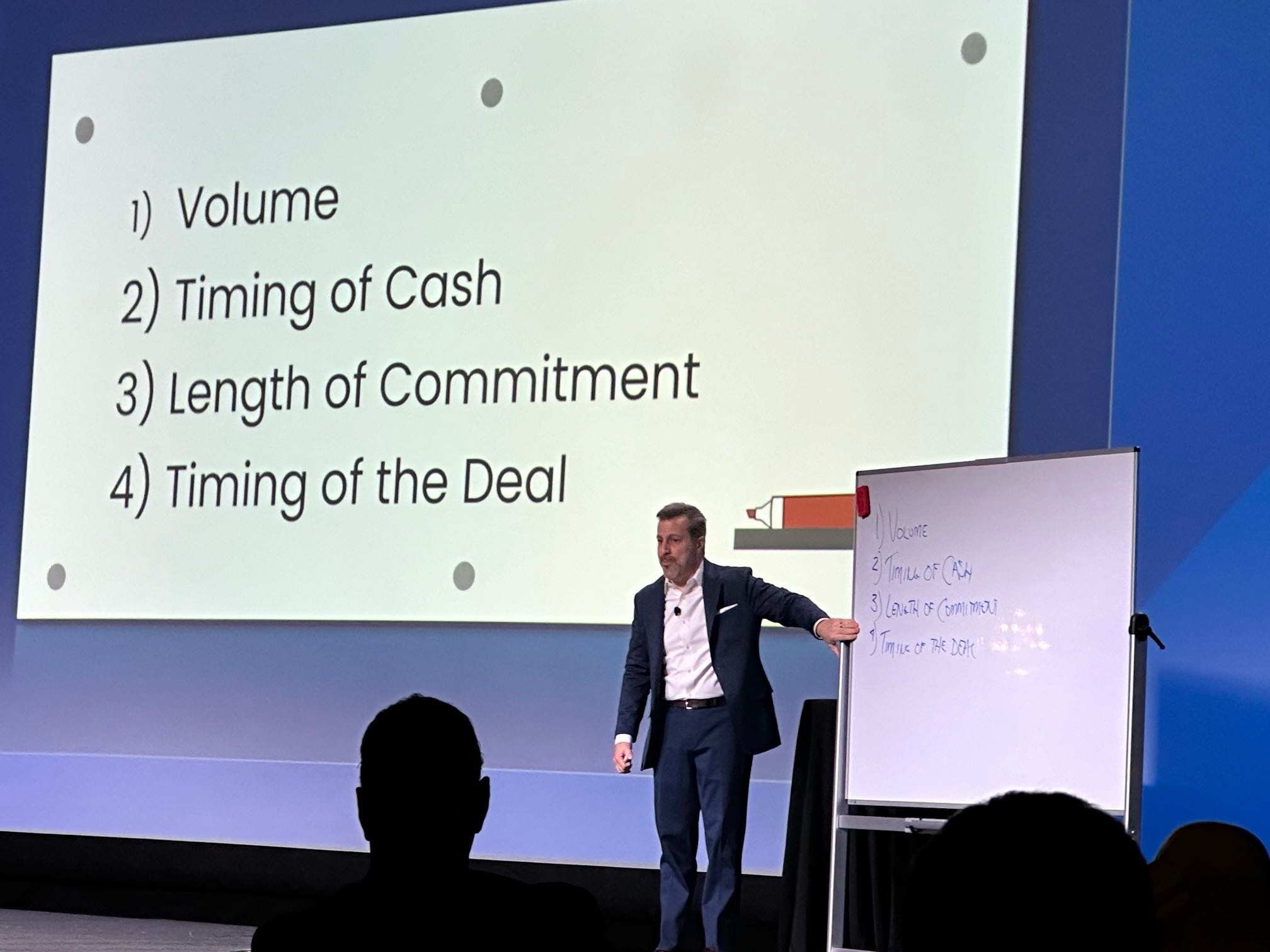
Your business is likely driven by four core elements. When used to position and propose your pricing, they become the architecture for an exchange-based system. In the process, your pricing becomes wholly consistent, where each customer pays the same amount based on their circumstances. Those four levers?
- Volume: Your pricing is likely based on what, specifically, the customer is buying, and how much of it they are committing to purchase. A larger volume commitment is better than a smaller one, and your pricing likely should reflect that.
- Timing of Cash: The faster a company pays for your product, solution, or services, the better that is for your organization. Faster payments should be rewarded over slower payments.
- Length of Commitment: The longer a company commits to your product, solution, or services, the better that is for your organization. Longer commitments should be rewarded over shorter commitments.
- Timing of the Deal: Your business thrives when there is predictability. A customer should be rewarded for helping you predict when the product will be needed, when resources to support the purchase may be needed, when payment will be received, etc.
Those Four Levers become a clear explanation for legitimate price differences. They provide a simple structure that makes different prices logical, consistent, and explainable. It provides a structure that allows your customers to trust that the price is consistent, which reduces discounting, speeds your end-of-cycle conversations, and builds trust versus eroding it.
For your new business deals, begin to arm your sales team with the language to use when discussing and proposing pricing. Your price is based on these four things. Cards-face-up.
For your existing deals, you’ll need to begin to have conversations with your customers who have indefensible disparities and gradually rightsize those differences during renewals and expansions.
In the process, you’ll find the anxiety salespeople often feel with the personality change so often required to negotiate a deal versus sell it dissipates. The conversations with customers become easier, because your Four Levers are also their Four Levers if they’re a for-profit, business-to-business organization.
And when done correctly, forecasting quickly becomes more accurate, too.
The bottom line, at least to me, is that AI is quickly going to make it easier for buyers to compare contracts, configurations, and pricing. Companies are going to need to be prepared to defend those differences. Are you ready?
***Grab a copy of Four Levers Negotiating wherever you get your books, in all formats. Or, even better, my Four Levers Negotiating Workshop is the most popular program I teach today, for sales, client success, and account management, all tailored to your pricing and the concessions your customers ask for. Reach out for more info.

Todd Caponi, CSP® fell into sales and fell in love with the decision science and history behind it. He’s held multiple sales leadership roles, helping build one company into Chicago’s fastest-growing, another to an IPO and nearly $3B acquisition, and earning a Stevie Award as Worldwide VP of Sales. Todd is the author of The Transparency Sale, ranked by Book Authority among the best sales books of all time, and the award-winning The Transparent Sales Leader. His latest book, Four Levers Negotiating, was released on January 27th. He now speaks and teaches revenue teams worldwide and hosts The Sales History Podcast.
Reach out (email to info@toddcaponi.com) – for inquiries about speaking at your event or sales kickoff, for programs to upskill your customer-facing teams and leaders, or just to nerd out on sales or sales history.
And while you’re at it, sign up for the newsletter, which comes out every other week.





0 Comments