
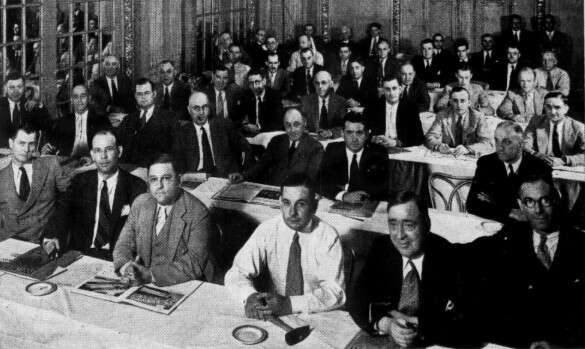
When Did People Start Hating Salespeople? The History Behind the Sales Stereotype
Over the weekend, I made a startling discovery about the decline in the perception of salespeople. I bored my wife by telling her this story, so now I’m gonna bore you all:
I’ve been asked this question a bazillion times. “So, when did people start hating salespeople?” and “Why do people hate salespeople?” Part of the answer is headslappingly obvious, and part came as quite a surprise – to me at least.
As you may have read in my past articles on the history of selling, or listened to in episodes of The Sales History Podcast, salespeople were considered gross for thousands of years. From the time of peddlers and drummers to into the late 1800s, as Thomas Hamilton wrote in 1833, “The whole race of Yankee peddlers in particular are proverbial for dishonesty.”
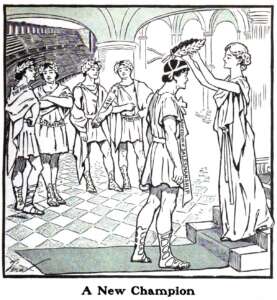
“A New Champion” a cartoon from 1907, depicting sales on equal footing with doctors and lawyers
However, with the advent of the Industrial Revolution came a new salesperson. In the early 1900s, the sales profession was so highly respected that it was taught in nearly every major college and even in many high schools.
By the 1950s, it was no longer taught in any schools. Companies visiting college campuses to recruit soon-to-be graduates into sales were greeted with students preferring to graduate without a job. Sales dropped back to the bottom of respected and admired professions.
What Happened?
Before this weekend’s find, the answer to this question was pretty straightforward and apparent. In the first quarter of the 20th century, machines were capable of producing large quantities of products. In conjunction with this, the country was also undergoing a massive expansion, including the opening of the West, so manufacturing was matching up with demand.
Eventually, the machines produced more products than the market needed. Extra inventory and idle machines are expensive! An economic pendulum swing started with the United States entry into World War I. Immediately following the war, pent-up demand created a booming economy. However, that was followed by an inflation spike, and eventually what is known as the “Forgotten Depression” of the early 1920s.
Desperation kicked in. Advertising spend went way up. Salespeople were trained to be high-pressure. The best salespeople were the ones who could “make them buy”.
The result? People started to hate salespeople. They were gross. Self-centered. Liars. Short-termism drove manufacturing organizations, and cost the profession its long-term reputation.
This was, and still is, my answer.
The Surprising Find
The US Government was blaming salespeople for the Great Depression! (Realizing that not everyone knows about it, the Great Depression was a worldwide economic collapse that began in 1929 after the U.S. stock market crashed, wiping out wealth, shutting down businesses, and putting millions of people out of work. It lasted through the 1930s, creating years of poverty, hunger, and uncertainty before governments and industries slowly rebuilt their economies.)
Many agreed. A 1943 edition of The Journal of Marketing detailed this perspective.¹
“This country’s greatest economic troubles have resulted from salesmen.”
– Arthur D. Whiteside, Head of Roosevelt’s War Production Office of Civilian Requirements, addressing the Sales Executives Club of New York
– Salespeople were accused of overstimulating demand through manipulative and deceptive selling.
– Salespeople encouraged consumption beyond actual needs, which led to unsustainable credit and continued overproduction.
– Salespeople’s pressure and persuasion eroded public trust and “distorted the natural balance between supply and demand”.
In reality, salespeople were likely not the cause of the Great Depression. Instead, it was a combination of the stock market crash, overproduction, high consumer debt, bank failures, and weak government policies. However, public sentiment, driven in part by a government deflecting blame, put much of it directly on the shoulders of the sales profession.
So there you have it. Following the Great Depression and as World War II was coming to a close, there was a realization: business ethics were highly connected to national well-being. The reputation established in the sales profession was that their lack of ethics destabilized the entire economy!
Oh, and the proposed solution at the time sounds like a plea for The Transparency Sale 75 years before I wrote it.

I’m Todd Caponi, CSP®. (<– links to LinkedIn)
I’ve written three books so far, The Transparency Sale, The Transparent Sales Leader, and my soon to be released Four Levers Negotiating.
I’m a sales keynote speaker and sales trainer, focused on teaching revenue organizations how to leverage transparency and decision science to maximize their revenue capacity.
It’s what I do…teach sellers, their leaders, well…entire revenue organizations how we as human beings make decisions, then how to use that knowledge for good (not evil) in their messaging (informal and formal), sales negotiations, sales presentations, and revenue leadership.
Reach out (email to info@toddcaponi.com) – for inquiries about speaking at your event or sales kickoff, for programs to upskill your customer-facing teams and leaders, or just to nerd out on sales or sales history.
- Sign up for the newsletter, which comes out every other week.
- Sign up to get on the launch list for Four Levers Negotiating.
- Pre-Order Four Levers Negotiating right now (releases January 27th, 2026), or reach out for bulk orders (> 10)
¹Jones, G. (1943). Salesmanship’s Responsibility for the Future. Journal of Marketing, 8(1), 75-78.




0 Comments