

Sales – A Trusted & Admired Profession?
Today, even through Covid, Gallup still shows the sales profession scraping the bottom of their most recent annual list of trusted professions…in the company of Members of Congress and Advertising Practitioners. Gross.
As the proliferation of self guided purchasing drives ecommerce, how is a sales profession to survive? What does the future hold?
To understand fully, it may be best to look back to a time when the sales profession was not only trusted and respected, but ADMIRED!
Sales Admiration in the Early 20th Century
So, let’s step back in time. Specifically, 105 years ago. 🧐
It was July of 1916. The United States was in the middle of World War One.
Yet, the World Sales Congress, a conference attended by 3,000 sales professionals, was gathering in Detroit, Michigan.
Even more counterintuitive, the keynote speaker was none other than President Woodrow Wilson.
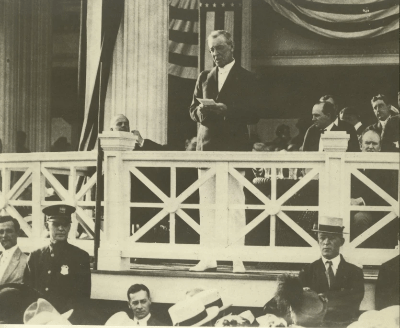
Why would a sitting President and Commander in Chief be speaking at a sales conference during a World War?
Because our country was depending on salespeople!
Sellers, bringing the right products to the right companies at the right time, were key to the country’s ability to achieve our potential.
The Industrial Revolution was in full swing. If the United States was to come out on top, it had to be through salespeople – bringing the right products, to the right companies, at the right time.
💡 An entire profession with a mission – putting the customer first for the good of all.
Losing our “Face”
So, what happened?
From what I can surmise, we, as a profession, lost our focus on the success of the customer, and instead shifted our focus to the success of ourselves.
The development of an unquenchable thirst for “scale”.
And what led to that shift?
Back in the early 20th century, to make a sale, it required a face-to-face interaction. There were no telephones. There was no email or Zoom. You could send a letter, and retailers were using mail order catalogs to secure sales, but real sales was human-to-human.
It was the only way.
As the late 1920’s arrived, the economy was turning for the worse. The Great Depression drove sellers into a “me, first” mode, which was certainly understandable. But what about afterwards?
The advent of technologies, like the telephone and much later email, caused us to lose our human connection with the customer. The customer became a number.
We lost our “face”. Our prospects no longer saw us, instead, they only heard our voices aggressively pressing them. They heard automations. They started buying things they didn’t need due to mistruths. They started hearing stories from friends about scams. Their dinners were interrupted by unwanted solicitations. They heard long, self centered voice messages. Their email inboxes started filling up with spam.
We started seeing our metrics instead of our customer’s eyes. ☎️
So, how do we regain our respect?
You have to be trusted to be respected.
Trust and respect requires a shift back to humanness in our profession. It requires a shift back to ensuring our customers and prospects truly believe we care about their outcomes, not just our bank accounts.
The best way to make a customer and/or prospect believe we truly care about their outcomes – is to truly care about their outcomes.
We have always known that transparency sells better than perfection.
In 1919, author Arthur Dunn was quoted as saying, “If the truth won’t sell it, don’t sell it.”
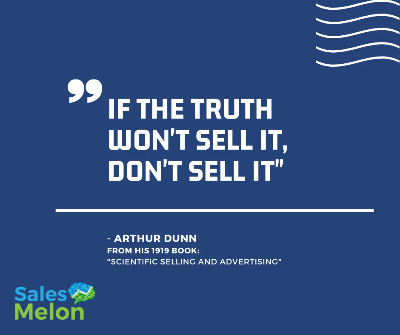
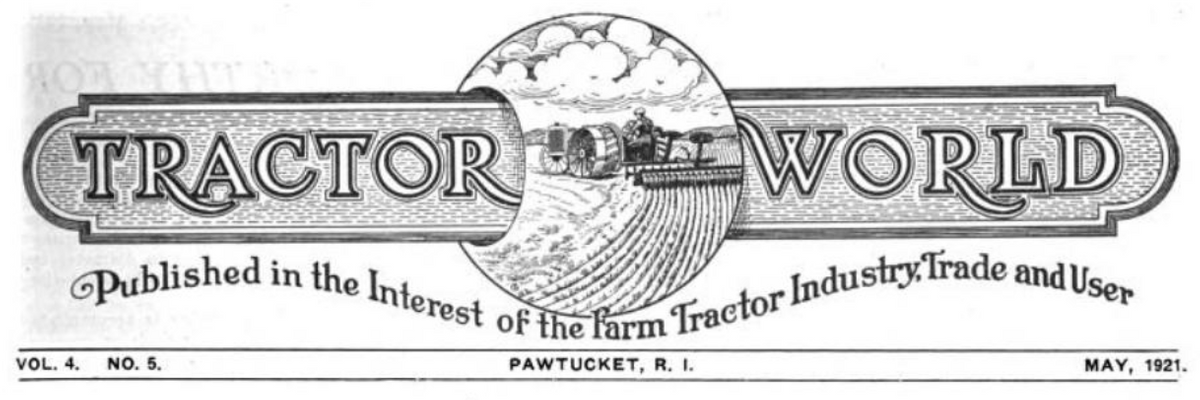
This was a theme at the time. Books with entire chapters dedicated to honesty. Even magazines like Tractor World advised in their May, 1921 edition, “If you’re representing an article that won’t stand the truth – get another job.”
That’s how sales is respected and trusted. And when those outcomes lead to strong businesses, which feed the economy and lead to massive job growth, it becomes a profession that once again regains admiration.
I believe the future of sales is radically transparent – not just because of what’s written above, but because due to the proliferation of reviews & feedback on everything we do & buy, it has to be.
Future sales professionals, in order to be a trusted and welcome resource versus a necessary evil, have to take on the role of aiding the buyer in making the right investment for their desired outcome, not for the sellers.
And when sales professionals do make that required shift, knowing that they can no longer get away with putting themselves first, the entire profession will be lifted up.
Now, we may not overtake nurses and veterinarians on the trusted professions ranking, but we can regain our status.
When we put our customers first, and our customers win, we all win.
What’s your prediction? Will the sales profession regain it’s 1910’s mojo?





0 Comments