

Tech Layoffs and The Monday Morning Quarterbacks
The economy. Layoffs. Banking issues. We’ve seen this story before. We know how it ends. We know we’ll see the story played out by a different cast at a later date.
And guess what! After the next round, we’ll once again see countless posts and proclamations that companies or individuals who overhired when times were good and are now laying off are stupid.
I’m not trying to be controversial. However, I am a bit stirred up by these individuals who have never been in the roles acting as though they would have done something differently. It’s the old “Monday morning quarterback” routine…where, sitting on your couch after the game, it sure is easy to proclaim how you would have made different decisions.
In reality, you probably wouldn’t have made different decisions.
Yes, some are not the brightest bulbs – and there are stories we can all point to of dumb decisions. The majority of leaders are, as Tyra Banks would call them, “flawsome”; flawed, but still awesome. They didn’t get into those roles by being stupid.
I don’t have a horse in the race here. I’m no longer running sales organizations and have thankfully never had to execute a RIF during any of my tenures in revenue leadership.
As we look through history, the economy has mirrored this environment multiple times. A period of steady growth, followed by a disruption, a boom, an inflation spike, then a recession…or, 102 years ago, a depression. It’s always followed by a refocus on profitable growth versus revenue-at-all-costs.
A quick peek at John G. Jones’s 1930 book, Sales Management tells us all we need to know.
“Sales management has learned that rising sales curves are frequently deceptive. Too often they indicate nothing but profitless prosperity. Intensive and extensive sales efforts cost money. And any undue emphasis upon volume without regard for ascertaining sales possibilities usually means a frenzy of high-powered selling which can only result in sales costs that mount sky-high.”
Yet, we don’t act differently the next time around. Why?
Because, organizational design is configured to always meet demand, and anticipated demand, with supply. Supply requires dollars and humans.
And when your competitors are doing it…
And when there is investment money and related investors involved…
And in a subscription economy, where the initial sale is an early milestone on the path to profitability and growth, not the peak…
…you throw in.
“But, Todd, what about the investors? They should have seen this coming!”

A 1927 article, where James H. Rand tries to convince us that a Depression isn’t coming. The Great Depression started less than two years later.
That’s partially true. They should have known that we, as an economy, step on this same rake over and over again. They should have seen the warning signs. However, in this 1927 article, James Rand was sure that we would never have another “depression” either. Less than two years later, in August of 1929, we began The Great Depression.
In it, Rand writes,
“At the risk of displeasing the professional prognosticators and the self-appointed prophets of disaster I hazard the opinion that the expected depression will not arrive – that at least it will be very different from the disastrous red-ink years we have through past experience learned to associate with the term “depression”.”
Predicting the future is hard. We will always match demand with supply. We will likely all see this again in our lifetime.
I’d just venture to say two things:
1) Not everyone who hired and subsequently fired is stupid. Let’s start there.
2) History repeats itself over and over and over again. Can we possibly use that fact to our advantage?
Maybe.
We absolutely know that we will enter a period where the focus is on profitability and cash flow. We absolutely know that the economy will grow over time. Always has. Always will.
However:
- There’s no way to predict how long this slowdown will last, and where the bottom will be, and,
- It only takes one unpredictable disruption to push the pendulum back high again, where it will inevitably swing until it calms into a period of steady growth. We saw it in March of 2020 with Covid. We saw it in September of 2001. We saw it with WW 2, WW1 and other circumstances that temporarily shut down the engine of business.
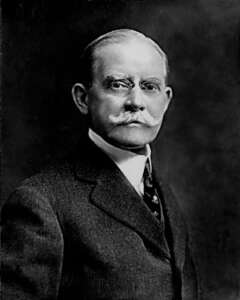
John Patterson – founder of NCR in 1884, and pretty much all that is the modern selling organization.
In one of my favorite John Patterson stories from the early 1900s, Patterson was riding in a cold Pullman. He asked the conductor why the train car was cold. The man launched into a long explanation essentially to ensure Patterson wouldn’t think it was his fault. Patterson didn’t care for the explanation, responding, “Let us say it is all my fault. That is out of the way now. What can you do about heating this car?”
None of you is perfect. Embrace it. Embrace that no leader makes perfect decisions all the time. Casting blame is a loser’s bet. Let’s just assume this is all my fault. With that out of the way, what are we going to do to help and prepare for what’s next?

I speak and teach revenue organizations on how to leverage transparency and decision science to maximize their revenue capacity. It’s what I do…teach sellers, their leaders, and really entire revenue organizations the how we as human beings make decisions, then how to use that knowledge for good (not evil) in their messaging (informal and formal), negotiations and revenue leadership. I wrote a 3x award-winning book (𝘛𝘩𝘦 𝘛𝘳𝘢𝘯𝘴𝘱𝘢𝘳𝘦𝘯𝘤𝘺 𝘚𝘢𝘭𝘦), and have a newish book out (𝘛𝘩𝘦 𝘛𝘳𝘢𝘯𝘴𝘱𝘢𝘳𝘦𝘯𝘵 𝘚𝘢𝘭𝘦𝘴 𝘓𝘦𝘢𝘥𝘦𝘳) now that just won its first award!
Reach out if you want to discuss The Transparency Sale sales methodology, or really…anything else (sales kickoffs, workshops, keynotes, the economy, history, etc.)! Email info@toddcaponi.com or call 847-999-0420.
Sign up for the newsletter for more of my nonsense in your inbox every other week, with some sales history sprinkled on top…Sign Up – The Transparent Newsletter




0 Comments