
The Beginnings of Sales Management
Where did sales management as we know it today come from? Times like these…
Where did aggressive “make the number” sales tactics come from? Same answer; times like these.
At the beginning of the 1900s, an executive’s core focus was “how to make things”. The emphasis was on manufacturing first – buying, financing, and building. “Selling was often turned over to a minor official of limited authority and responsibility.”
Selling started to become worthy – and worth of having a “full-time supervisor”. In John G. Jones’s 1930 book, Sales Management, he writes that most often, just like many in today’s world, “a sales manager was chosen from the ranks of the selling force on the sole basis of his success in selling goods. Almost any vigorous and supremely confident traveling salesman would do.” We hear this all the time today, don’t we? Sales managers are often just top salespeople promoted…and that doesn’t always equate to success. As a matter of fact, it rarely seems to.
“Then, as always, the importance of sales management depended upon the importance of the field-selling job.”
In other words, when the economy is strong, sales management becomes less important. As the economy slows, the sales function becomes more important, as does the sales manager.
Prior to 1907, most salespeople were selling what they called “barehanded”. Companies weren’t yet providing much assistance to the salespeople. The majority were still using drummers, supplying them with samples, sending them out on their own, and paying their commissions. “That was the extent of sales management.”
During that period from 1900 until 1907, the market developed tremendously, as did the complexity and variety of its wants. There were higher standards of living developing and greater purchasing power, so the demand for things was growing, too. The electric-power industry was rising, the internal combustion engine was becoming more broadly used, and travel and transportation were quickening through the improvements to the transmission of power. The very rural areas of the country were now easily within reach, too.
Business communications grew and expanded into small towns and rural communities.
Still, “sales management was haphazard and hit-or-miss, because field selling was generally smooth-sailing.”

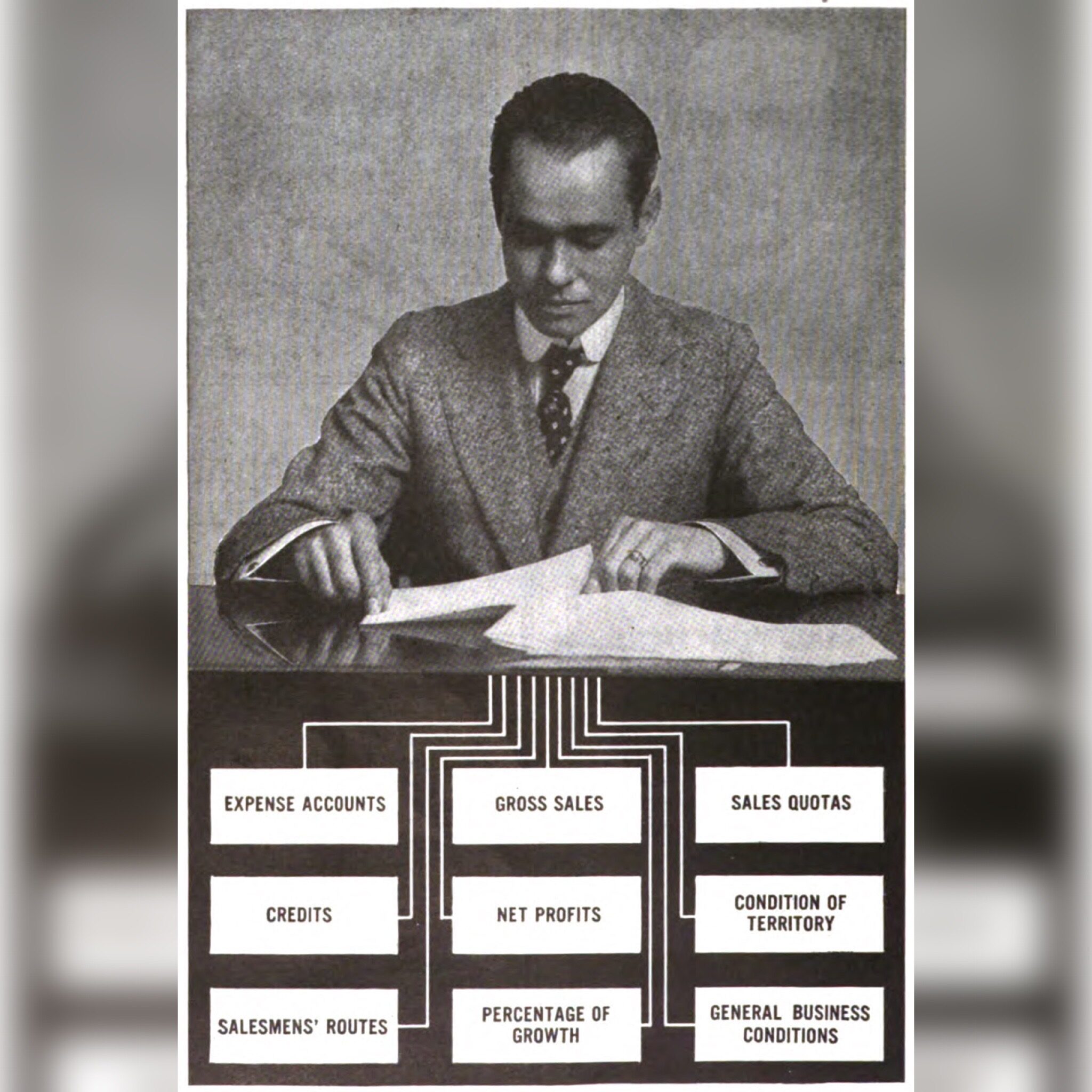
Sales Manager’s Responsibilities – 1915
Starting in 1907 through about 1914, things got tougher. The country’s industrial capacity was starting to catch up with the market demand. Production increased more rapidly than the population. At the same time, companies had developed more advanced organizations – so corporate efficiency was a part of that increase – “scientific industrial management”, advanced engineering skills, and just better equipment. In other words, everything was being optimized – catching and passing the corresponding buying power of those who could be sold to. So sales management found itself on the defensive.
Tougher times required better sales leadership.
The duties of sales management suddenly multiplied. Advertising took on a new significance as a sales method. Specialized sales promotion was born – and “the infant was handed over to the sales manager to nourish and rear.”
According to Jones, from 1914 until World War I, “field selling was order-taking alone”. It was a sellers’ market again. “Goods were bought faster than they tumbled off the factory’s assembly line”.The primary role of sales managers? To “drowsily attempt to excuse delivery delays.”
The war ended with an economic boom (similar to post-Covid March 2020), followed in late 1919 (October) by a stock market crash. “The long arctic night of 1919-1921 set in”. Companies were liquidating inventories, production came almost to a stop, and organizations were purging their entire sales teams. Sales management suddenly sprang to life once again.

Role-playing, called “Mock Sales” in 1922
Sales managers were on the hook to optimize their team’s focus, the personnel, their talents, the tools they used, and their overall mindset.
Some did it right – focused on optimization.
Some didn’t – and the reputation of sales as a profession began its own “long arctic night”.
As the depression of the early 1920s came to a close, we began to see the first true signs of high-pressure selling tactics and “of generous and sometimes blatant advertising”. Sales managers were hiring again, buying advertising, and “cracking the whip as they demanded volume.”
There’s another lesson here…that we know, yet we ignore. It sounds like this…from this 1930 book:
“Sales management has learned that rising sales curves are frequently deceptive. Too often they indicate nothing but profitless prosperity. Intensive and extensive sales efforts cost money. And any undue emphasis upon volume without regard for ascertaining sales possibilities usually means a frenzy of high-powered selling which can only result in sales costs that mount sky-high.”
That’s 1930. Revenue at all costs wasn’t a good idea back then? Who knew!?!
Therein lies the challenge. Sales volume in the manufacturing world had to be grown and sustained consistently in order to obtain economies of scale for large-scale production. But, the costs of selling, when they eat up those economies of scale, eventually come crashing down the entire operation.
“The problem of sales management at the moment is not the problem of taking orders or of making sales in large numbers at any cost. It is the problem of making sales in large volume and at low cost. It is the problem of eliminating waste and inefficiencies by systematic and scientific procedures. Old fashioned and easy-going methods must be discarded along with high-powered and go-getting methods.”

In 1922, salespeople from the Wahl Corporation were…”closely supervised”.
That, from 1930. That should also be from today.
While I’ve now read 56 books from 1890-1930, there are piles of pieces of sales management theory and history sprinkled in those pages. This is just a start…a summary above, but the lesson here is significant. As the economy stumbles along, and especially when it rises back up like it did in 1921, it’s up to you, leaders. Your importance and contribution to the success of your teams and organizations rely more on you now than during a market upswing.
Which path will you choose?
Invest in yourself! Organizations…invest in your leaders! I *cough* know someone who can help (me) and a *cough* *cough* book that can help (The Transparent Sales Leader).

I speak and teach revenue organizations on how to leverage transparency and decision science to maximize their revenue capacity. It’s what I do…teach sellers, their leaders, and really entire revenue organizations the how we as human beings make decisions, then how to use that knowledge for good (not evil) in their messaging (informal and formal), negotiations and revenue leadership. I wrote a 3x award-winning book (𝘛𝘩𝘦 𝘛𝘳𝘢𝘯𝘴𝘱𝘢𝘳𝘦𝘯𝘤𝘺 𝘚𝘢𝘭𝘦), and have a newish book out (𝘛𝘩𝘦 𝘛𝘳𝘢𝘯𝘴𝘱𝘢𝘳𝘦𝘯𝘵 𝘚𝘢𝘭𝘦𝘴 𝘓𝘦𝘢𝘥𝘦𝘳) now that just won its first award!
Reach out if you want to discuss The Transparency Sale sales methodology, or really…anything else (sales kickoffs, workshops, keynotes, the economy, history, etc.)! Email info@toddcaponi.com or call 847-999-0420.
Sign up for the newsletter for more of my nonsense in your inbox every other week, with some sales history sprinkled on top…Sign Up – The Transparent Newsletter



0 Comments