
The Great Sales Irony of Prohibition
If you were a salesperson around 1918 and were asked what the concept of “Prohibition” would mean to the sales profession, your answer probably would have been “less drinking, less entertaining, more professionalism.”
As it turns out, in the 1920s, the opposite happened.
From my research, I can’t help but think about how ironic this is, but also the damage it caused to the profession at the time.
As the 1800s were wrapping up, the sales profession was associated with booze. The era was dominated by the concept of the traveling salesman “drummer”, who carried products around the country for whoever they represented. They were essentially nomads, living in hotels, loud, and charismatic. But, they were also known as being hard-drinking individuals, who backslapped and told jokes to their sales. Show the products, then entertain.
However, as the Progressive Era of the Industrial Revolution unfolded, the profession began to change. Companies were growing up, needing to hire their own salespeople, train them, and give them dedicated territories.
No longer could they hire a “drummer” to go into a town, drink and lie their way to sales, then move on to the next town never to be seen again. Relationships at the local level mattered. Product knowledge, customer diagnosis, and service now meant everything.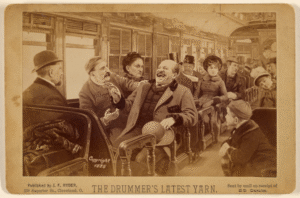
So, less back-slapping meant less alcohol and much more professionalism. Trust went up. Respect and admiration for the profession went up. And the economy did well because of it, too!
In 1924, Sheffield Sealect News talked about the time:
“The day is gone when a man can hit booze and be a tough and still make good as a salesman. No man can become a real salesman until he can learn to control his own body and mind and soul.”
A few years earlier, Price’s Carpet and Rug News had described the ideal salesperson as someone defined by integrity, respectability, reliability, and professionalism.
By the end of the 1910s, the profession had largely succeeded in distancing itself from the stereotype of the drinking drummer. Alcohol no longer played an active role in the profession…until, ironically, Prohibition came along.
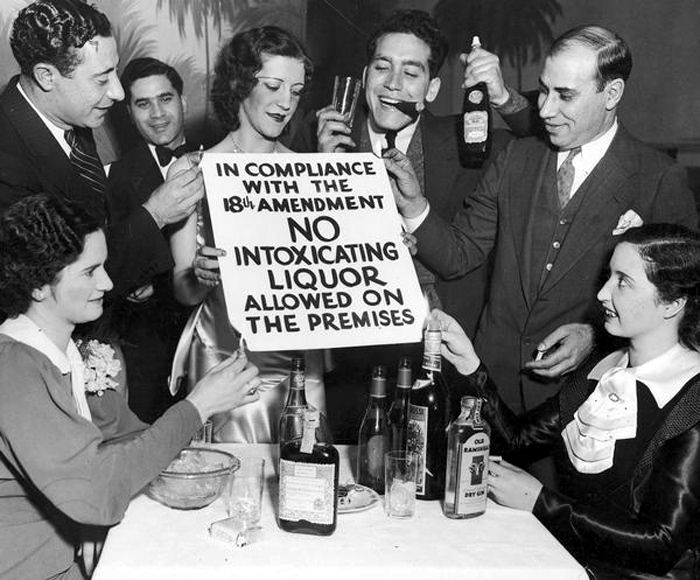
In 1919, the Eighteenth Amendment to the US Constitution was ratified, prohibiting the manufacture, sale, and transportation of intoxicating liquor. It was written so that three-fourths of the states had to ratify it within seven years, or the amendment would just go away.
Well, the states hit the three-fourths threshold in just over a year, so it became the law. The Volstead Act soon followed, defining what qualified as alcohol and establishing how the law would be enforced.
The amendment and the act didn’t prohibit drinking alcohol. It prohibited making it and selling it. The thought was that as alcohol became unavailable, it would disappear from American life, and so would all the problems associated with it.
Instead, the scarcity of alcohol made its value go up exponentially.
A remarkable 1925 article in Sales Management magazine titled “Buying Business Via Booze” argued that Prohibition had “put a halo around a bottle of whiskey and given it an entirely new value in the eyes of thousands of people.“
Before Prohibition, booze was ordinary. However, after Prohibition, it became exclusive. Possessing a bottle of whiskey made you one of the cool people. It signaled influence and status, and quickly became highly valuable in the sales world.
One company reportedly kept whiskey locked in its company safe. Whenever an important buyer arrived in town, a bottle was delivered directly to the buyer’s hotel room.
Another organization reportedly spent more than $30,000 on liquor to entertain convention attendees. In today’s dollars, that’s over $500,000!
How do you compete today? Your product, service, maybe your pricing, reputation, etc. During Prohibition, companies competed based on whether they had access to liquor.
The profession spent two decades (~1895 to ~1918) rebuilding trust through service. While there were other reasons why the perception was dropping, namely the drive to a “high pressure sales” approach due to the Forgotten Depression of the early 1920s, prohibition made things even worse in the 1920s.
What’s interesting is that much of the data shows that alcohol consumption went down during Prohibition. But, as an executive from the Heywood-Wakefield Company argued, there was a commensurate rise in what he called “vocal drinking”.
People talked about drinking constantly. The cool kids were all drinking, and you wanted to be one of the cool kids.
He even described a salesman who made one bottle of whiskey last eighteen months.
The volume of alcohol consumption isn’t really the point. Alcohol became something people wanted to be associated with because its scarcity grew its social value.
My favorite line from all the reading on this era came from a guy named George F. Earnshaw, President of The Earnshaw Sales Company. He argued that his salespeople won’t show up with booze, they’ll show up with ideas. Their role was to be a guide, and help buyers achieve optimal outcomes through a service lens…even if those ideas weren’t directly related to the company’s own products.
The quote:
“Ideas are of more value than booze.”
It’s a beautiful blend of The Transparency Sale and The Challenger Sale.
Prohibition ended in 1933. Alcohol became legal again. Its scarcity disappeared.
Over time, corporate America developed entertainment policies, gift limits, expense reporting, and conflict-of-interest rules that attempted to answer the very questions sales executives were debating in 1925.
I’d like to think we’re getting back to our early 1900s ways of professionalism, transparency, and service. We still entertain – maybe it’s a suite at a ballgame, a high-end dinner with drinks, maybe some other sort of special experience, but I feel like we always need to be careful:
Where is the line between relationships and differentiated influence?
A line from a 1927 edition of Furniture World Magazine put a stamp on the point:

Arthur Sheldon – the G.O.A.T. of sales philosophers
“YOU can be pretty sure that when a salesman has to offer a buyer a drink to make him buy, that the merchandise is as bad as the booze.” and “It doesn’t speak very highly of the buyers, if they can’t buy without first taking a drink.”
It always goes back to this:
“True salesmanship is the science of service. Grasp that thought firmly and never let go.” – Arthur Sheldon, The Art of Selling, 1911
Let’s try to remember not to let go…

Todd Caponi, CSP® fell into sales and fell in love with the decision science and history behind it. He’s held multiple sales leadership roles, helping build one company into Chicago’s fastest-growing, another to an IPO and nearly $3B acquisition, and earning a Stevie Award as Worldwide VP of Sales. Todd is the author of The Transparency Sale, ranked by Book Authority among the best sales books of all time, and the award-winning The Transparent Sales Leader. His latest book, Four Levers Negotiating, was released on January 27th. He now speaks and teaches revenue teams worldwide and hosts The Sales History Podcast.
Reach out (email to info@toddcaponi.com) – for inquiries about speaking at your event or sales kickoff, for programs to upskill your customer-facing teams and leaders, or just to nerd out on sales or sales history.
And while you’re at it, sign up for the newsletter, which comes out every other week.



0 Comments