
The Impact of AI on Sales: A 70-Year Perspective
Every few weeks, I hear, “Todd, this time it’s different. AI is changing everything. We’re in the greatest sales technology revolution of all time.”
Maybe.
But then I, again on a Friday night (nerd), read an article from December of 1954 called “Mechanization of the Modern Sales Department”*.
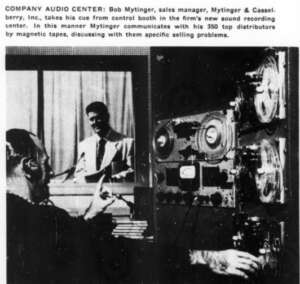
Company Audio Center 1954
72 years ago, it started with this idea: “Sales success often depends on a company’s ability to communicate vital marketing information quickly, precisely.”
Reps were in the field. The communication advancements made in World War II were now making it into industry. That meant:
- Radio-paging salespeople in the field
- Installing private telegraph wire systems between offices
- Using closed-circuit television to launch products
- Recording sales meetings and distributing them on disks
- Mechanizing data collection for forecasting
- Using punch tape to integrate communications
- Recording phone calls to improve selling effectiveness.
Workflow of how WWII communication devices were being used in the field as paging devices for salespeople in the 1950s.
One company bragged that it had created a “digital nerve center”. Another study examined how microwaves could more effectively transmit weekly sales and inventory reports, enabling executives to make faster decisions.
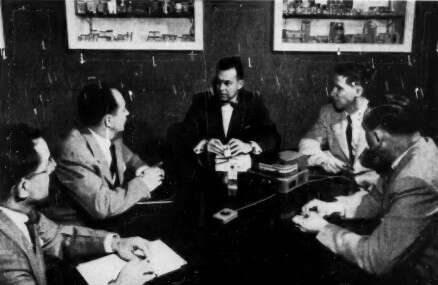
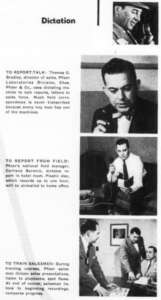
Pfizer scaled its sales force 5000% using dictation machines to train and report more efficiently. (Article’s header image is Pfizer recording meetings, shared and filed)
The old airline TWA improved reservation sales performance by recording calls and reviewing them with reps.
Not 2024…1954.
- The printing press in 1440 made standard messaging scalable
- The telegraph in the 1830s made long-distance coordination possible
- The telephone in the 1880s transformed sales communication – and obviously prospecting
- Automobiles expanded territories into the early 1900s
- Air travel shrank geography, beginning mainly in the 1950s
- Dictation machines revolutionized sales training in the 1950s
- Radio and microwave networks accelerated communications and reporting after WWII
- Computers, email, CRM, sales engagement tools, video, AI…
At every stage, the sales world proclaimed, “This changes everything!”
And, in all fairness, it obviously changed a lot – in terms of the same outcomes we’re chasing today with AI and all its goodness.
Faster communication, better reporting, reduced paperwork, greater control, more accurate forecasting, improved service – the optimization of the sales professional so they can spend more human time with customers.
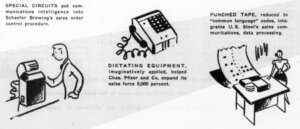
1954 Tech Modernization
Selling, done right, has always been service. It’s always been human. The “everything” that’s changed is the technology, not the behavior.
- Humans still make decisions the same way.
- Humans still establish and build trust the same way.
- Clear communication still wins.
- Optimal friction removal still wins.
- Customers don’t buy when they’re convinced…they buy when they can predict. That hasn’t changed, either.
Being the one nerd reading all this old sales stuff, generation after generation, each has believed it’s standing on the edge of transformation.
The tools have changed, but that’s not the transformation. The tech amplifies whatever philosophy sits under it.
If you want to trick, manipulate, gimmick, or pound your customers, the technology is better at that than ever!
If you want to be a better human being, embrace transparency, develop trust, and build long-lasting, mutually fruitful relationships, the technology is better at that than ever, too.
You decide…
* Sales Management 1954-12-15: Volume 73, Issue 14.

Todd Caponi, CSP® fell into sales and fell in love with the decision science and history behind it. He’s held multiple sales leadership roles, helping build one company into Chicago’s fastest-growing, another to an IPO and nearly $3B acquisition, and earning a Stevie Award as Worldwide VP of Sales. Todd is the author of The Transparency Sale, ranked by Book Authority among the best sales books of all time, and the award-winning The Transparent Sales Leader. His latest book, Four Levers Negotiating, was released on January 27th. He now speaks and teaches revenue teams worldwide and hosts The Sales History Podcast.
Reach out (email to info@toddcaponi.com) – for inquiries about speaking at your event or sales kickoff, for programs to upskill your customer-facing teams and leaders, or just to nerd out on sales or sales history.
And while you’re at it, sign up for the newsletter, which comes out every other week.





0 Comments