
The PRAISE Model – Driving Salespeople Intrinsically
What motivates salespeople? What actually drives them?
If your answer is, “Salespeople are coin-operated,” I’d argue you’re right, if you’re doing it wrong. Sustainable engagement and motivation in a sales organization happen when extrinsic motivators like pay and variable compensation become the reward for doing the work we love, rather than the reason we do it.
When I first moved into a revenue leadership role, running a sales organization, nobody taught me how to do it. I had to figure it out on my own. That “figuring out” came from my previous experiences be led by others, observing what I felt worked, and what did not. Then, I did the research. And in that research, there was a gap in what was being taught.
Where are sales and revenue leaders being taught how to drive a sales organization to want to show up every day, stay, put in their best effort, put in discretionary effort, and tell their friends? Because when that part of the sales leader’s role is optimized, performance goes up, turnover goes down, and the speed at which they can hire high-quality talent goes down considerably, too.
Smarter people than me have done the research on intrinsic motivation and engagement. What does that mean?
- Intrinsic – meaning inside-out. Something within you that drives you.
- Extrinsic – meaning outside-in. Something given to you positively or negatively that drives you (money, awards, etc.)
The best organizations have been getting intrinsic motivation right for well over 100 years.
I spent gobs of time applying that to salespeople – but NCR knew chunks of it way back then!
The best performance comes from the best teams. AND, the best teams are NOT always the most talented.
The best teams are often the ones who consistently put in the effort, never stop learning & growing, come together as a team, and feel as though they are on a mission.
So, how do we get teams to come together, consistently put in the effort, and find an unquenchable thirst for learning? In the pages of behavioral science, we can uncover the true drivers of “intrinsic inspiration”: a state where you are inspired to be fully engaged and put in discretionary effort by things inside you (intrinsic), versus things outside you (extrinsic), like rewards or punishments.
What kind of advantage would sales and revenue leaders have if they knew how to build teams that consistently stay, bring their best every day, perform, and become advocates?
It feels like a huge opportunity. Use behavioral science for good, not evil.
Through my readings, research, and application, I’ve found models out there…but none of them spoke to me as being great for those who care about driving revenue. I kept studying, and ended up with a whiteboard full of intrinsic drivers. The result? I created a model…a model that, when internalized, can guide teams to drive your business beyond numbers and paychecks.
I call it the PRAISE Model of Intrinsic Inspiration.
The PRAISE Model of Intrinsic Inspiration
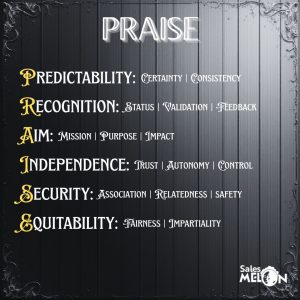
The PRAISE Model of Intrinsic Inspiration
There are six primary categories of motivators. Understand them. Internalize them. Write them on a notecard and keep them by your desk. I dedicated an entire section of my second book, The Transparent Sales Leader, to diving into each – giving you ideas and ways to establish, grow, and maximize each element. Here they are:
Predictability: We, as human beings, do best in situations or environments with predictability. We don’t do our best in environments when team members have feelings of uncertainty, inconsistency, and instability.
Example: You walk into the office (back when we used to do that sort of thing), and see your boss walking towards you. Your boss has her head down, doesn’t make eye contact, and doesn’t acknowledge you. Your brain goes into survival mode – “Wow, she must hate me! I must have done something wrong. Wow, I’m in trouble.” Maybe she just has something on her mind…but our brains are wired to think the worst.
There’s a meeting taking place where your peers are participating, and you weren’t invited. “Wow, they must not value my opinion.” Maybe they’re planning your birthday party. Maybe those individuals are getting reprimanded for not being as awesome as you. Again – it’s our brain’s protection mechanism, instantly thinking the worst.
Your manager seems angry. “I’m in trouble. What did I do? Ugh, I wonder if my job is at risk.” It could be that he closed his garage door on his car that morning, found a hole in his favorite underwear or he simply woke up with a headache – all of which have nothing to do with you, but again, our brains are wired to protect against the worst.
Moral: Are you creating an environment where, when your team goes to bed at night, they can predict what tomorrow will bring? With layoffs abound, have you even addressed it? Or are they thinking the execution could come in the morning, harming their sleep, performance, and creativity? Are you consistent as a leader? Do they know what version of you will be there to greet them tomorrow?
Recognition: We, as human beings, do best when performance recognition, status, and feedback are available. Individuals tend to work less and for shorter periods when they feel their efforts are not acknowledged and validated.
Example: Years ago, while holding ten $100 bills, I walked into the area where all of our corporate (inside) sellers were located. I told the team that, for the next ten deals that closed with annual recurring revenue over $10,000, I would walk out and hand the sales rep one of the $100 bills.
We closed ten deals over $10,000 in annual recurring revenue in a shorter period of time than we had ever accomplished as an organization.
Mind you, the average commission on such a deal for the rep was 8.5%. The average deal size of those ten deals was $21,000. So, the average commission a rep received for closing said deal was $1,785.
Was it the $100 that drove the additional motivation extrinsically? Or was it the pageantry of the delivery of the $100 bills and their name on the board as one of the ten?
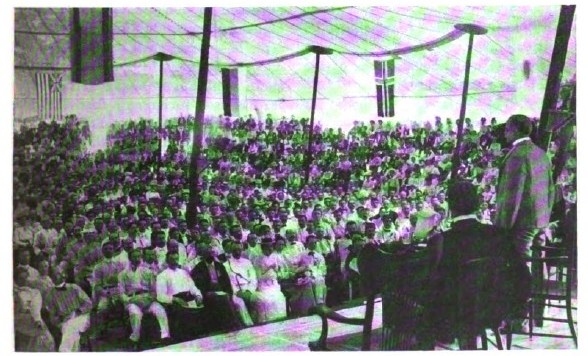
In 1904, NCR engraved its top salespeople’s names in bronze. Many wanted that more than a big paycheck.
Worthington C. Holman wrote about the power of “recognition” in 1905.
NCR recognized their salespeople across the organization so emphatically that…
▪️ “If he is a leading agent, elevator boys stare at him with more awe than would be excited if he were a National League baseball pitcher. Clerks and office boys point him out to each other and quote his records.”
▪️ “At the end of certain periods, the names of leading agents are engraved on a bronze tablet on the outside of the administration building of the factory. The eagerness of National agents to win the honor of getting their names on this tablet will not be believed by casual readers.”
▪️ “The spirit of pride runs so high that most men would rather have the honor of leading in these contests than pocket the money that goes with the honor.”
Moral: Are you regularly pointing out the efforts, achievements, and successes of each team member? Are they getting feedback to understand where they’re excelling, and where there’s opportunity to excel? Are there ways to create opportunities to inspire recognition amongst the team?
Aim: We, as human beings, do best in situations or environments where there is satisfaction in purpose, mission, helping others, or making an impact beyond just ourselves. Individuals are less likely to do their best when they feel as they are just a number with a number (i.e., a quota), and their work doesn’t matter beyond their forecast.
Example: When I was the Chief Revenue Officer for PowerReviews, we sold ratings-and-reviews technology to retailers and brands. Who cares?
The end consumer cares; they leverage those ratings and reviews to make smart decisions with their limited incomes and make life better for themselves and their families.
One of my clients sells accounting software. Who cares?
The Chief Financial Officer and her staff care because their technology helps accountants get their weekends back to spend with friends and family, instead of working around the clock each quarter to close their books on time.
Moral: Does your team know what their work means to you, your customers, and their customers? Figure it out and share it often.
Independence: We, as human beings, perform best when having control over ourselves and our environment. Individuals are less driven in environments where they lack autonomy, others’ trust, and the resources to succeed. In other words, performance suffers when we’re micromanaged.
Example: Think about the all remote or hybrid selling organizations. Maybe you’re having daily check-in with the team, asking everyone what they’re working on. So, each day, those team members spend a half-hour coming up with a story about what they’re going to tell you, their boss, what they’re working on so you’ll leave them alone until tomorrow.
In my first sales role, selling overnight shipping for Airborne Express, I was required to write down every single cold call I made – needing to make 250 per week. I didn’t last. I wasn’t inspired. I spent an hour a day padding my stats and data to keep my job, instead of performing my best.
Moral: Are you giving your team the tools, resources, and training to do their best work with the least amount of supervision?
Security: We, as human beings, do best in situations or environments where we feel safe and part of a pack. Individuals are less likely to stay and perform their best when they feel alone, at risk, and/or as though others don’t have their back.
Example: When the world shut down for COVID, the connection we had to one another in a remote environment eroded along with it. The solution? Zoom happy hours. Lots of them! When layoffs coincided with being alone, it was like being in a forest full of bears by yourself at night. A connection had to be re-established! Teams outperform individuals.
Moral: Do your team members feel like they’re connected, and that others “have their back”? Would your team members hang out with each other if they weren’t connected by their job? How many of your team members have a best friend at work?
Equitability: We, as human beings, do our best when the reward (which may include the P.R.A.I.S.E. elements above or an extrinsic reward) is perceived to be fair. Individuals do less when they feel the “juice isn’t worth the squeeze”, or when others receive a different level of reward for a similar effort.
Example: Think of any situation where you see others who are doing less, performing less, or less talented than you perceive yourself to be getting paid more, recognized more, promoted more, or, in general, rewards you aren’t getting. Quick path to disengagement, right? Politics should be kept in government, not the world of selling.
Moral: Cards-face-up leadership. Ensure everyone feels like the rewards they get for their time and effort are worth it. Eliminate favoritism, and when you suspect their may be perceived instances of someone “getting paid more for the same job”, address it. If it’s true, fix it. If it’s not, embrace it and share it.
Once you internalize the six elements, you can see where you fall short, what opportunities you have to improve the environment, build team spirit, and see discretionary effort rise.
- Predictability
- Recognition
- Aim
- Independence
- Security
- Equitability
Praise them! They show up, perform, stay, and advocate – higher performance, lower turnover, faster time to hire great people.
IMAGE: NCR’s 1904 sales “convention”, or what we would call a sales kickoff today. John Patterson is addressing the group.

Todd Caponi, CSP® fell into sales and fell in love with the decision science and history behind it. He’s held multiple sales leadership roles, helping build one company into Chicago’s fastest-growing, another to an IPO and nearly $3B acquisition, and earning a Stevie Award as Worldwide VP of Sales. Todd is the author of The Transparency Sale, ranked by Book Authority among the best sales books of all time, and the award-winning The Transparent Sales Leader. His latest book, Four Levers Negotiating, was released on January 27th. He now speaks and teaches revenue teams worldwide and hosts The Sales History Podcast.
Reach out (email to info@toddcaponi.com) – for inquiries about speaking at your event or sales kickoff, for programs to upskill your customer-facing teams and leaders, or just to nerd out on sales or sales history.
And while you’re at it, sign up for the newsletter, which comes out every other week.


0 Comments