

The Rise of the Deplorable Salesperson
The Roman Empire…
What comes to your mind when you hear those three words? Strength, patriotism, and heroes. In what was referred to as “The Eternal City”, we probably don’t consider the peddlers and merchants.
In the final two centuries B.C., the streets of Rome were filled with the sounds of “the barking of the hucksters”. It was a time when Rome had transitioned from being a “republic” to an “empire”. Business was great. Actually…too great. Shields and swords were put to the side, replaced by an unquenchable thirst for gain.
Rome was overrun by salespeople, jamming traffic in a wild scramble for business – where main streets started to resemble a fairground filled with booths of people selling things. It became a profession so reviled that, in one story, salespeople were round up and murdered by the tens of thousands.
Where I found all this
In 1924, author Roscoe Gimore Stott wrote an article in a magazine called How and What To Sell about a time when the sales profession was maturing – and it wasn’t what I expected. He wrote of this period of time of the two centuries before 0 A.D. – so the period between 200 B.C. and the year 0. Stott was a poet in his day job, having written a number of books that have nothing to do with business or sales. As a result, this article was pretty difficult to understand. However, he referred to a book published by Harper’s in 1880 by an author named “Dr. Herbermann”. He added, “I might do no better than to give this entire segment of our historical study to him.” That was it – all Stott referred to in the article.
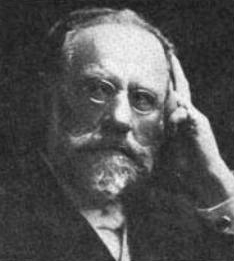
Dr. Charles G. Herbermann, professor and historian (1840-1916)
As you might imagine, I couldn’t let that go, so off I went on a research project – what book, who was Herbermann, and how do I get my hands on it? Well, I was successful. The 1880 book was titled, Business Life in Ancient Rome, written by Dr. Charles G. Herbermann. I found a digital copy, and have read it three times in the past week to make sense of it all (the book is only 77 pages long).
A Time of “Money” over “Virtue”
Herbermann (1880) wrote, “The world was at their feet, its luxuries at their command, its wealth at their mercy. What wonder if they stretched forth their hands and plucked the tempting fruit?” The Roman Empire became money mad. Even the most adored philosophers and poets spoke of the need to put money above all else.
For example, Quintus Horatius Flaccus, known in the English-speaking world as Horace, was the leading Roman lyric poet during the time of Augustus. He lived between 65-27 B.C., and wrote:
“Seek money first, good friends, and virtue next:
Each Janus lectures on the well-worn text;
Lads learn it for their lessons; gray-haired men,
Like schoolboys, drawl the sing-song o’er again” – Hor., Ep. I, i, 53-6
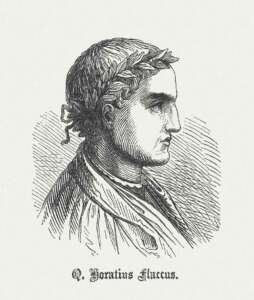
Quintus Horatius Flaccus, known in the English-speaking world as Horace
Horace was advocating for putting money ahead of friends and virtue, along with teaching children this prioritization.
Juvenal, known at the time to be the most powerful of all Roman Poets, wrote:
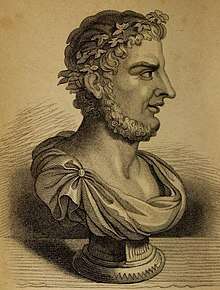
Juvenal
“It matters not what you may sell,
Of profit fragrant is the smell.
Keep on thy lips, morn, noon and night,
This teaching of the bard, that might
Do honor to the gods above –
Nay, even, I should say, to Jove.
No one will ask whence comes your gold;
Have it you must, say young and old.
This principle the toothless nurse
Does to the crawling boy rehearse;
This girls upon their parent’s knee
Must learn before their A B C.” – Juv, Sat. XIV, 204-9
Juvenal preached to all who will listen the fragrant smell of profit, the idea that nobody will know where you get your money…just get it, and like Horace, he spoke of the need to teach children this way of thinking.
At the time – towards the end of the Republic and during the first centuries of the “Empire”, the population of the region was around 1.5M people. It was made up of a highly diverse population who had come to Rome, from “every clime and every nation”. Individuals there “to provide for all the wants and luxuries of this motley multitude, immense supplies must be brought from every quarter of the globe.”
Of the 1.5M people, it was estimated that at least 900,000 were slaves, whose “monthly allowance was a bushel of corn, a pint of oil, and a little wine”. Many were even worse. In spite of this “starvation board and starvation wages, immense quantities of provisions were consumed by the population of the metropolis.”
For those who were the “haves” versus the “have nots”, “the fare of the rich was as sumptuous as the food of the poor was mean.” Emperors like Nero, Verus and Heliogabalus spent $240k to $400k on a single banquet – it was expected. In some cases, individuals who weren’t emperors “were guilty of this imperial folly”. For example, the actor Marcus Gavius Apicius was said to have spent “$4M on the pleasures of the table, took poison, because, having only $400,000 left, he saw starvation staring him in the face.”
Of course, it wasn’t just food – other luxuries kept pace – everything from flowers, perfumes, ointments, clothing – millions were spent per year on these things. Marble and bronze statues were everywhere. And the furniture! Famous tables were all the rage.
Rome and the Romans money-first-mania was like a national plague during the Roman Empire in the last century B.C. Stores had inscriptions on their doorways such as Salve lucrum, which meant “Hail profit!” and “No place for idlers here; loiterer, away!”
How Bad Did It Get?
“Double-crossing became a fine art”
Roman peddlers and merchants began to take this outside of Italy. Swarms took goods out widely beyond in hopes of finding fortunes. As it turns out, other countries weren’t having this deplorable behavior, putting a stop to it in the worst way possible. In Herbermann’s book, he found that in 88 B.C., 80,000 of these traders, peddlers and merchants from Rome were murdered in Asia Minor (which is now Turkey). In Delos, which was one of the biggest commercial centers along the Mediterranean, 20,000 more fell victim.
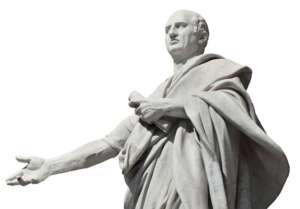
Cicero, a Roman scholar & philosopher
Roman merchants became pervasive in Africa. They were all over Gaul (which is a region that now is present-day France, Belgium, the Netherlands, Luxembourg, and parts of Switzerland, Germany, and Northern Italy). The Roman scholar Cicero (who, ironically was beheaded himself in 43 B.C.) said that “not a pennyworth was bought or sold in Gaul that did not appear in the ledgers of the Roman bankers.” – There was a massive accumulation of immense fortunes.
It got to a point where the stories of trickery and sliminess were everywhere. One common scheme was upselling a family on how their deceased family members would be cremated. They were promised the high brow way, which was to be cremated with “pure cassia”. In reality, they were being cremated with a little cassia and a lot of cherry bark. Apparently, that was not so fancy.
Clothing and drapery was being sold that would fade as soon as they were hit with sunlight. “The modern housewife must be on guard against deceitful ‘bobs”’
Herbermann went on to say, “Whether there were at Rome any honest, on-price stores, we know not; we do know that some Roman signs show us the customer haggling with the salesman, as if it were an inducement to the buyer to know that a trader was not obstinate in his prices.”
The Government Stepped In
Eventually, the Roman government put a stop to this approach to selling.
“For if the vendor is a pest, even more so is the squatter with mercantile desires. He rises everywhere out of nowhere. In the very Forum, scene of oratorical glory, in the Campus Martius and along the streets he appears in such numbers that at length the emperor, himself, is compelled to break up the evil.”
He went on to explain,
“Martial, the poet, thanks Domitian for curbing this nuisance. He closes with “No blackened inns now fill the street. Barber and butcher, innkeeper and cook. Beyond their premises now stray no more. Hail, Rome once more! On Rome again we look; “T” was one vast wilderness of shops before.”
The Lesson – From R.G. Stott
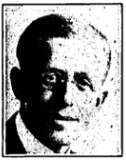
Roscoe Gilmore Stott, Litt. D. 1924
In Stott’s 1924 article, he left us with a final lesson that is both ironic in how it still applies today, but so well written that I cannot attempt to better it.
“The Roman citizen was not much different from the modern business trickster who in his short sighted way thinks, ‘Hurray for myself, to Hades with everybody else’”
“Salesmanship is too glorious an occupation to be so debauched. And yet in our own times many well-meaning sellers imitate the Roman vendor and squatter. Our product appears best when displayed with dignity. The man who sells a worthy product need have no apology in his heart. Yet there are methods and methods. The Roman sellers became pests.”

I speak and teach revenue organizations on how to leverage transparency and decision science to maximize their revenue capacity. It’s what I do…teach sellers, their leaders, and really entire revenue organizations how we as human beings make decisions, then how to use that knowledge for good (not evil) in their messaging (informal and formal), negotiations, and revenue leadership. I wrote a 3x award-winning book (𝘛𝘩𝘦 𝘛𝘳𝘢𝘯𝘴𝘱𝘢𝘳𝘦𝘯𝘤𝘺 𝘚𝘢𝘭𝘦), and have a newish book out (𝘛𝘩𝘦 𝘛𝘳𝘢𝘯𝘴𝘱𝘢𝘳𝘦𝘯𝘵 𝘚𝘢𝘭𝘦𝘴 𝘓𝘦𝘢𝘥𝘦𝘳) now that just won its first award!
Reach out if you want to discuss The Transparency Sale sales methodology, or really…anything else (sales kickoffs, workshops, keynotes, the economy, history, etc.)! Email info@toddcaponi.com or call 847-999-0420.
Sign up for the newsletter for more of my nonsense in your inbox every other week, with some sales history sprinkled on top…Sign Up – The Transparent Newsletter




0 Comments