

Transparent Does NOT Always Win! There, I said it.
In sales and leadership, transparency wins when done correctly, through the correct lens of your responsibility.

The Transparency Sale: How to use transparency throughout the sales cycle
In sales, transparency done right speeds sales cycles, increases win rates, qualifies IN the opportunities you should be working better, qualifies OUT the deals you’re likely to lose anyway – but faster, makes competing against you more difficult, and helps you differentiate in the way that you sell.
In leadership, transparency done right helps your team to predict, which increases engagement, team members who stay longer, perform better, and become advocates for you and your organization.
We know, at a subconscious level, that perfection doesn’t exist. If you’re presenting your solutions as all-things-to-all-people and a perfect 5-stars out of 5, you are actually making it harder for your buyers to reach a decision, not easier. If you are presenting yourself as King Perfect, who sees all and knows all, guess who doesn’t believe it? Everyone.
The proliferation of information hasn’t made life easier for buyers, it’s made it more challenging. That’s where transparency comes in – doing the homework for the buyer, presenting both the pros and the cons.
It’s why you all read the negative reviews first when buying a solution online.
It’s why a product with all 5-star reviews doesn’t sell as well as one with an average star rating between 4.2-4.5. That’s when a website is acting as a salesperson, but also when you, as a human being, are acting as the salesperson.
When Transparency Fails:
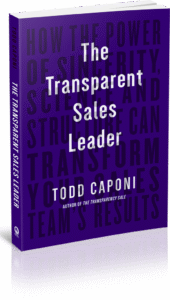
The Transparent Sales Leader: The structure of revenue leadership, optimized by science, on a bed of transparency.
So, when is transparency in sales and leadership a bad idea? Put simply, it’s when transparency doesn’t help buyers or your team members make better decisions and perform better.
Confidential Information:
Transparency does not mean the revealing of company or personally sensitive information. Being transparent about company secrets has long-lasting negative impacts on you, your company, and your customers. When competitors can take what you’ve shared and use it against you, that’s oversharing, and in some cases, illegal oversharing. There are laws that protect certain types of information.
Be smart. Putting your company at risk is not using transparency to help a buyer. Understand the balance.
Complex Information:
Transparency done right is knowing your audience. Sharing information that is overly complex and detailed can not only overwhelm, but can cause those individuals receiving that information to come to false conclusions.
Remember your role – it’s not to convince a buyer to buy, it’s not to convince your team member to do something, it’s to help them predict. It’s to do the homework for them. The proliferation of information, feedback and avenues to access said information on everything we do, buy, and experience has made it harder for individuals to reach conclusions, not easier. Provide a service by putting yourself in that individual’s shoes, and present information that will help them predict, achieve optimal outcomes and do so as quickly as possible.
“This is why we suck!”
Being transparent doesn’t mean showing up with a laundry list of all the reasons why you suck. There’s a reason companies buy from you. But, there are also reasons they don’t. There are reasons why you’re a great leader, but you’re not perfect. Instead, you likely are as Tyra Banks calls it, “flawsome” – flawed, but still awesome.
And if you do suck, or your products suck, or you’re not a good fit for that prospect, embrace the words of Arthur Dunn from 1919, who said “If the truth won’t sell it, don’t sell it.” If your product sucks, you shouldn’t be selling it. If you don’t believe what’s being proposed is a good idea, be transparent about it. Win fast. Lose fast. Build everlasting trust.

Orison Swett Marden
You’re providing a service to your potential clients. Help them predict! Share the pros and the cons in as empathetic a way as possible; if you were in their shoes, what would help you predict whether this is a great fit?
“Sincerity, genuineness, transparency, carry great weight with us all. Just think what it means to have everybody believe in you, to have everybody that has ever had any dealing with you feel that, there is a man as clean as a hound’s tooth and as straight as a die; no wavering, no shuffling, no sneaking, no apologizing, no streak of any kind in his honesty; you can always rely on his word. There is a man who has nothing to cover up; he has no motive but to tell the truth; he doesn’t have to cover up his tracks because he has lied once and must make his future conduct correspond; he knows that honesty needs no defense, no explanation. His character is transparent. One doesn’t need to throw up guards against him.” – Orison Swett Marden, The Art of Selling, 1916
#transparencywins

I speak and teach revenue organizations on how to leverage transparency and decision science to maximize their revenue capacity. It’s what I do…teach sellers, their leaders, and really entire revenue organizations the how we as human beings make decisions, then how to use that knowledge for good (not evil) in their messaging (informal and formal), negotiations and revenue leadership. I wrote a 3x award-winning book (𝘛𝘩𝘦 𝘛𝘳𝘢𝘯𝘴𝘱𝘢𝘳𝘦𝘯𝘤𝘺 𝘚𝘢𝘭𝘦), and have a newish book out (𝘛𝘩𝘦 𝘛𝘳𝘢𝘯𝘴𝘱𝘢𝘳𝘦𝘯𝘵 𝘚𝘢𝘭𝘦𝘴 𝘓𝘦𝘢𝘥𝘦𝘳) now that just won its first award!
Reach out if you want to discuss The Transparency Sale sales methodology, or really…anything else (sales kickoffs, workshops, keynotes, the economy, history, etc.)! Email info@toddcaponi.com or call 847-999-0420.
Sign up for the newsletter for more of my nonsense in your inbox every other week, with some sales history sprinkled on top…Sign Up – The Transparent Newsletter





0 Comments