
Your First 30-60-90 Days As a Sales Leader
A few years ago, I was invited to interview for a Chief Revenue Officer role at a tech company based in Chicago. I was the 13th candidate they had interviewed for the role.
The question you’d expect to be asked came up: “How would you approach the first 30, 60, 90 days?” How would you answer?
My answer got me the job. And it wasn’t some sort of gimmick; it was a simple framework for maximizing the revenue capacity of the team, coupled with a logical approach to its application in the role.
Background:
Going back a few years to when I landed in my first sales leadership role, it struck me…
“Wait…as a salesperson, I always had a process, a structure, a foundation. Where is my sales leadership process?” I was immediately stressed out. Advil became my co-pilot. I felt like a dog chasing a car down the street.
So, like a nerd, I created a revenue leadership process and structure. It became my companion for all my planning, all my communications, my structure for 1-on-1s, my agenda for board meetings, and my fallback when the heat went up in the kitchen (i.e., the pressure is on).
That framework also meant I always had a 30-60-90-day plan in my back pocket. I could immediately go up to a whiteboard and walk through it. It made me sound really smart, and I could use all the help I could get.
However, it made me smart. It created a proactive way to see the entirety of a revenue engine, identify the holes, and communicate them consistently. We often get stuck in the “pipeline” silo, then look at the things that create or destroy pipeline. This framework fixes that.
(and, if you really want to dig in, the book, The Transparent Sales Leader, walks through the framework, then digs in to optimize each one. I also teach the entire revenue leadership program to larger leadership organizations (20+), and via a cohort style through Sales Assembly for the smaller ones)
So, here’s your plan:
There are five categories of responsibilities for a revenue leader. Every driver of revenue falls into one of the five buckets. Once you internalize the five, they become your foundation for how you plan. So, in the first 30 days, we’re starting by assessing our…
- Focus: Does our team optimize their time, working the right opportunities and sell to the right organizations/individuals? How much of our time is on “science projects”? Where should we be wholly focused?
- Field: Based on our Focus, do we have the right team taking the field every day, with the right tools and the right resources?
- Fundamentals: Does my team do the right things right consistently – from prospecting to close and everything in between?
- Forecast: Are we able to consistently predict the future, and see the holes before they form through measuring the right metrics, using them the right way?
- Fun: Is the team intrinsically inspired, wanting to show up doing their best every day, put in discretionary effort, and are willing to advocate for our company?
What’s missing here? Our leader’s ability to coach? That would be in Fundamentals, and would span all five categories. Our onboarding? That would in a combination of Field and Fundamentals…where Field includes the “resources”, and Fundamentals focuses on where to direct their time.
In the first thirty days, these five categories should be laid out, assessed, holes identified, and fixes prioritized.
The next thirty days? Putting a plan in place to optimize each category and the priorities. Execution of those plans should already be happening.
If, after 60 days, you haven’t actually done anything but assess and plan? You’re probably in trouble.
By the 60-day point, things should be happening, rhythms should begin to be taking shape, and you’re already making your way down the list of priorities.
That’s it.
The Interview
Going back to the interview discussed above, when I was asked what my 30-60-90-day plan would be, I rattled this off:
“Early in my leadership career, I built a revenue leadership framework for myself. Every responsibility of a revenue leader falls into one of five categories. (1) Focus, or where the team spends their most valuable inventory they can convert to revenue…their time, (2) Field, which is the team, the tools, and the resources, (3) Fundamentals, meaning the skills that need to be consistently executed, (4) Forecast, which is the predictability, planning, and metrics, and (5) Fun, which is the culture.
“In the first 30 days, I’ll break down the current state of each of these categories, identify the opportunities, prioritize them, and begin making adjustments. By day 60 we will have made our way through the big opportunities, we’re establishing a rhythm, and making our way down the list…”
You’ll sound like a master. And, if you actually do this, you’ll be a master.
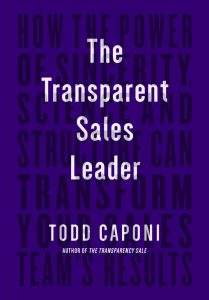
The TSL book is the framework, optimized by science, on a bed of transparency.
Internalize the Five F’s of Maximizing Revenue Capacity: Focus | Field | Fundamentals | Forecast | Fun. And grab a copy of The Transparent Sales Leader to learn the framework more deeply, and how to optimize each element within it.
Two Additional Pieces of Advice for the New Sales/Revenue Leader:
1) The “peers versus boss” speech:
I always said the following to my teams right out of the gate – because I meant it. “I’m nobody’s boss. We are peers, just with different responsibilities.”
What does that mean? It means that as a revenue leader, my responsibility is to clear the field of obstacles, maximize the revenue capacity of the entire team and everyone in it, predict the future through the forecast, and establish a culture where everyone wants to be there and perform. The salespeople? They are the mouthpiece of the organization. They have a responsibility to drive the revenue of the organization. I help them. They, in turn, help me.
Leadership can be really lonely. I always felt like one of the team. Years later, I’m still in a text group with many of my team. But, even better…I never had a problem asking my team to report. Focus mattered, even in reporting, but my team always knew the “why” behind the ask…help me, help you.
2) Teach them something immediately:
Be sure you teach them something in the first week. In my last CRO role, I took the team into a room and taught them my Four Levers Negotiating framework in the first week. They used it immediately, and most of them still do today.
Once you internalize the Five F’s, you now have a 30-60-90 day plan in your back pocket at all times. You’ll have all the elements that contribute to the maximum revenue capacity of the team. You’ll sound smart. You’ll be smart. You’ll stand out.
Let me know if you get stuck…

Todd Caponi, CSP® fell into sales and fell in love with the decision science and history behind it. He’s held multiple sales leadership roles, helping build one company into Chicago’s fastest-growing, another to an IPO and nearly $3B acquisition, and earning a Stevie Award as Worldwide VP of Sales. Todd is the author of The Transparency Sale, ranked by Book Authority among the best sales books of all time, and the award-winning The Transparent Sales Leader. His latest book, Four Levers Negotiating, was released on January 27th. He now speaks and teaches revenue teams worldwide and hosts The Sales History Podcast.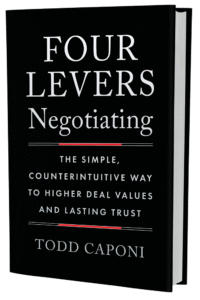
Reach out (email to info@toddcaponi.com) – for inquiries about speaking at your event or sales kickoff, for programs to upskill your customer-facing teams and leaders, or just to nerd out on sales or sales history.
And while you’re at it, sign up for the newsletter, which comes out every other week.


0 Comments